
- The Nationwide Association of Judges “Aequitas” asked Poland’s National Council of the Judiciary (NCJ), under the procedure for access to public information, to clarify the scope of the position adopted on June 29, 2026 by the Council’s Presidium. In its reply, the NCJ conceded that the position does not concern the analysis and assessment of appointments to judicial office.
- This is a success of pressure from the legal community – judges’ associations and the Ordo Iuris Institute – which, from the moment the position was announced, consistently pointed out that any attempt to challenge concluded judicial appointment proceedings would be devoid of a legal basis and contrary to the Constitution.
- The reply does not, however, dispel all concerns – quite the opposite: it remains unclear what exactly will be examined by the team appointed by the new Chair of the NCJ, which is still supposed to analyze “the proceedings conducted by the so-called neo-NCJ.”
- The hypocrisy of the position itself also remains: the NCJ denies legitimacy to the two previous compositions of the Council, even though they were elected on the basis of exactly the same provisions and in the same procedure as the current composition.
On July 8, 2026, the Nationwide Association of Judges “Aequitas” announced the content of the reply it had received from Poland’s National Council of the Judiciary in response to its request for access to public information. The association had asked the Council to clarify the scope of the position adopted on June 29, 2026 by the National Council of the Judiciary’s Presidium – the same position in which the Presidium announced that it does not recognize the positions and assessments of legal acts adopted by the Council between 2018 and 2026, and about which we wrote a week ago. According to what the association reported, the Council’s reply is brief and unequivocal:
Did the NCJ back down under pressure from the legal community?
Let us recall: on July 1, 2026, a communiqué on the position adopted two days earlier by the Council’s Presidium was published on the NCJ’s website. It stated that the Presidium:
does not recognize the positions and assessments of legal acts adopted by the NCJ in the period from March 6, 2018 to May 15, 2026.
At the same time, it was declared that the Chair of the NCJ would appoint a team whose task would include analyzing:
“the proceedings conducted by the so-called neo-NCJ.”
As we pointed out, this last wording could be read as heralding an attempt to challenge the concluded judicial appointment proceedings of 2018–2025 – that is, the resolutions on the basis of which the President of the Republic of Poland has appointed judges over the past eight years. Such action would, moreover, constitute a circumvention of Article 180 of the Constitution, which permits a judge to be recalled from office only by virtue of a court judgment, in the instances prescribed in statute, and not on the basis of any actions by the NCJ – especially ones undertaken without a legal basis.
The reaction of the legal community was immediate and unequivocal. A critical position was taken by the association Veritas et Ius – In the Service of the Nation. Judge Kamila Borszowska-Moszowska publicly asked Poland’s Minister of Justice which provision of the Act on the National Council of the Judiciary authorizes the Council, or a team appointed by it, to reassess resolutions, positions, and proceedings from 2018–2025. The “Aequitas” association itself pointed out in turn that the NCJ has no legal basis for processing the personal data of candidates from proceedings that have already been concluded. Finally, the Ordo Iuris Institute has for months consistently pointed to the unlawfulness of any attempts to undermine the status of appointed judges, in particular in the opinion submitted for the record of the public hearing (in Polish) on the government’s bill on restoring the right to an independent and impartial court by regulating the effects of resolutions of the National Council of the Judiciary adopted in the years 2018–2025, demonstrating the flagrant conflict of such measures with Article 180 of the Constitution. It is worth emphasizing that the team appointed by the Chair of the NCJ, mentioned above, is to prepare its position precisely with regard to this unconstitutional bill.
The “Aequitas” association did not, however, stop at criticizing the NCJ’s communiqué; it went a step further and simply asked the Council – under the Act on Access to Public Information – what its position actually means. The reply, quoted above, means that the NCJ has officially conceded that its position covers neither the analysis nor the assessment of appointments to judicial office. It is hard not to see in this the effect of coordinated, substantive pressure from the legal community. As the association itself aptly put it:
pressure works.
The “success” is that a state organ declares it will not break the Constitution
It is worth realizing, however, what the success in this case actually means. Under Article 179 of the Constitution, judges are appointed by the President of the Republic of Poland, on the motion of the NCJ, for an indefinite period – upon appointment, the nomination procedure is definitively closed. In turn, the already-cited Article 180 of the Constitution expressly provides:
1. Judges shall not be removable.
2. Recall of a judge from office, suspension from office, transfer to another bench or position against his will, may occur only by virtue of a court judgment and only in those instances prescribed in statute.
The declaration that the Presidium’s position does not concern the analysis and assessment of appointments to judicial office therefore in essence amounts to an assurance that, at least in this respect, the NCJ will not be breaking Article 180 of the Constitution. While in a state in which the organs of public authority genuinely function on the basis of, and within the limits of, the law (Article 7 of the Constitution) such a declaration would be obvious, in the realities of the Tusk EU-backed government’s so-called “restoration of the rule of law,” “militant democracy,” and “transitional justice,” it must – unfortunately – be recorded as a success – which best shows how low the bar set for organs of the state is in today’s Poland.
Can the whole matter therefore be considered clarified? Not necessarily. The information that the team appointed by the Chair of the NCJ is to analyze “proceedings conducted by the so-called neo-NCJ” is still on the NCJ’s website. What, then, is to be the specific subject of its analysis, if not the appointment proceedings?
Moreover, as we have already recalled, the team’s position is to be presented to the Council in connection with the bill on restoring the right to an independent and impartial court by regulating the effects of resolutions of the National Council of the Judiciary adopted in the years 2018–2025 (Sejm print no. 2107). That bill – as we demonstrated in the above-mentioned opinion of the Ordo Iuris Institute – provides for the removal of judges appointed since 2018 from their posts by operation of law, without a court judgment. Perhaps, then, the Council itself, fearing liability, will not dare to take any formal steps aimed at removing judges appointed since 2018 contrary to the requirements of Article 180 of the Constitution, but will instead carry out “analyses” that will serve the legislature to justify introducing solutions incompatible with that very article of the Constitution?
The current NCJ still differentiates its status from that of the previous compositions, even though it was elected on the same legal basis
The reply given to “Aequitas” does not, however, touch at all on what is perhaps most striking in the position of June 29 – its point of departure. The Presidium justified the need to adopt the position by:
the defective formation of the judicial part of the Council in the period from March 6, 2018 to May 15, 2026.
Meanwhile, as we have written many times, this charge is entirely misplaced – and, coming from the current Council, downright self-discrediting. The current composition of the NCJ was elected on the basis of exactly the same provisions – Article 9a et seq. of the Act on the NCJ – and in the same procedure as the compositions of 2018 and 2022. Provisions which, in the Constitutional Tribunal’s judgment of March 25, 2019 (ref. K 12/18), were found to be consistent with the Constitution.
Summary
The reply given to the “Aequitas” association gives grounds to hope that the current composition of the NCJ nevertheless has certain reservations about undertaking openly unconstitutional actions. Questions and doubts still remain, however – in the meantime, a notice of the following content has appeared on the NCJ’s website, displayed to everyone immediately upon entering it:
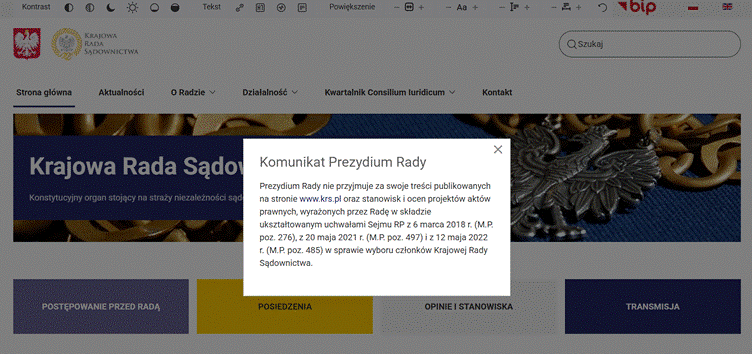
Screenshot from the website: https://krs.pl/pl/
The Presidium of the Council does not adopt as its own the content published on the website www.krs.pl or the positions and assessments of draft legal acts expressed by the Council in the composition formed by the resolutions of the Sejm of the Republic of Poland of March 6, 2018 (M.P. item 276), of May 20, 2021 (M.P. item 497), and of May 12, 2022 (M.P. item 485) on the election of members of the National Council of the Judiciary.
As can be seen, then, the current composition of the NCJ is clinging firmly to the entirely groundless narrative that its status is materially different from that of the two previous compositions – even though those were elected in exactly the same procedure. It therefore remains necessary to follow the work of this body closely – especially that of the announced team – watching out for whether some other ideas are lurking behind it, equally, if not even more, incompatible with the Constitution.
Source of illustration: iStock.