
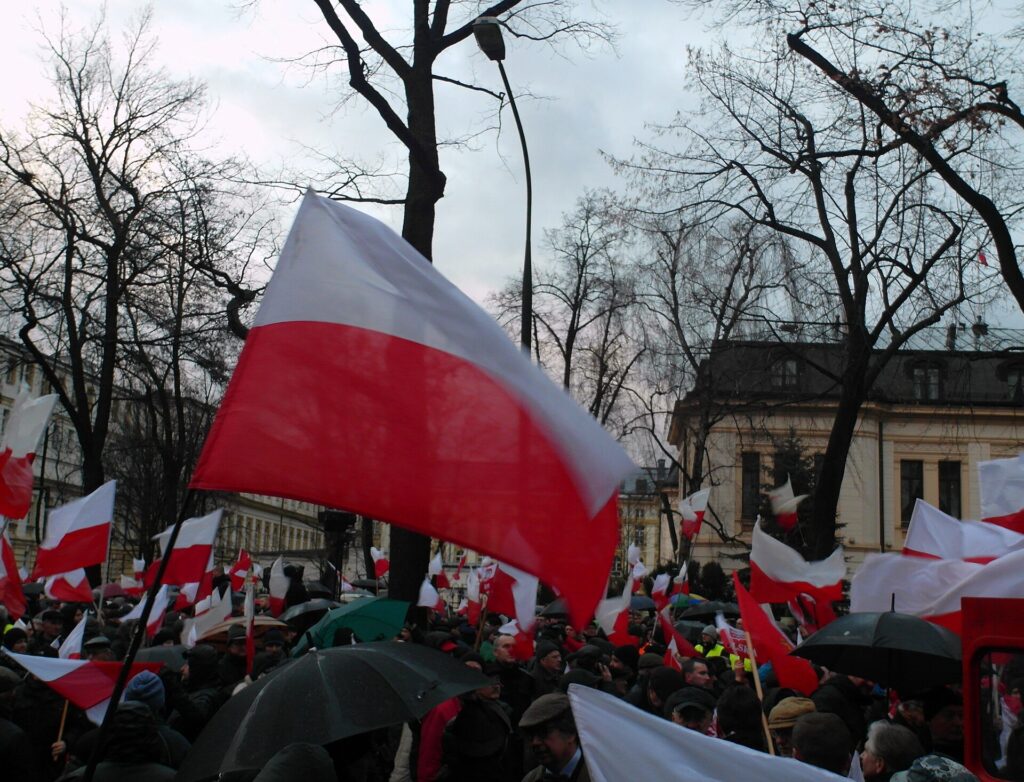
- On October 16, 2026, prosecutor Andrzej Piaseczny, accompanied by police, entered the headquarters of Poland’s Constitutional Tribunal, demanding the handover of documents and CCTV recordings. The President of the Tribunal handed them over voluntarily so as not to escalate the situation, but deemed the incursion a potential criminal offense.
- The prosecution service’s actions raise serious doubts in light of the principle of the independence of courts and tribunals, and they may also be aimed at forcing the President of the Tribunal to admit to adjudication persons who have not taken the oath before the President of the Republic.
- The incursion came two days after Prime Minister Donald Tusk declared that, with regard to the Tribunal, the government would not retreat a single step – further escalation can therefore be feared.
Two days ago, we reported that Maciej Berek, a former minister in Donald Tusk’s government, recited the oath of a judge of Poland’s Constitutional Tribunal in the office of the Speaker of the Sejm, Poland’s lower house of parliament – bypassing the President of the Republic, before whom, under Polish law, the oath must be taken. When Berek then tried to enter the judges’ section of the Tribunal’s building, its President, Bogdan Święczkowski, barred his way pending a reply from the President of the Republic as to whether he recognizes this oath. President Karol Nawrocki declared the very same day that Berek is not a judge of the Constitutional Tribunal.
Now the government has gone a step further: on October 16, 2026, the Constitutional Tribunal (TK) announced in a statement yet another incursion into its headquarters:
Prosecutor Andrzej Piaseczny, together with Police officers, has arrived at the headquarters of the Constitutional Tribunal and is attempting to search the headquarters of an independent organ of judicial power.
The President of the TK, Bogdan Święczkowski, decided to hand over the requested documents voluntarily. At the same time, however, he publicly stated that, in his view, the incursion was provocative in nature and met the elements of the offense under Art. 128 of the Criminal Code, namely exerting influence on the official activities of a constitutional organ of the state by force or unlawful threat. The President of the Republic of Poland was notified.
Andrzej Piaseczny is a member of the so-called Team for Preventing the Negative Effects of Rulings, set up by Justice Minister and Prosecutor General Waldemar Żurek, whose real main purpose is to harass judges appointed since 2018. As the prosecutor in charge of the case, he is conducting the investigation into the alleged refusal to admit to adjudication four persons elected by the Sejm on March 13, 2026. This investigation is groundless, since the only persons not admitted to adjudication are those who have not taken the oath before the President of the Republic, as expressly required by Art. 4(1) of the Act on the Status of Judges of the Constitutional Tribunal – and under Art. 5 of that Act, the service relationship of a judge of the Tribunal is established only after the oath has been taken. In these very proceedings, the prosecution service in September charged the Director of the TK Chancellery and the Commander of the Tribunal Guard – officials performing their duties exactly as the law requires and who, being in no way decision-makers, have been treated here as scapegoats in place of the President of the TK, who enjoys immunity. Piaseczny himself had already entered the Tribunal with police on July 14, 2026, during the General Assembly of TK Judges, seeking to have persons who had not taken the oath admitted to it – but he left fairly quickly, without achieving anything.
The prosecution service’s own actions suggest, however – and the National Prosecutor’s Office in fact confirmed this in its official statement – that the demand for the handover of materials stemmed above all not from the abovementioned investigation itself, in which the dispute concerns the law and the facts are widely known, but from the criminal complaint filed by Maciej Berek alleging a violation of his bodily integrity.
Two points should be made here. First, the President of the TK firmly denied the allegation, pointing out that it was in fact the former minister who had tried to force his way unlawfully into the closed section of the TK and that, in accordance with the law, he had to be prevented from doing so.
Second, under Art. 217(3) of the Criminal Code, a violation of bodily integrity is an offense prosecuted by private indictment. In Polish law, this means that – unlike publicly prosecuted offenses, in which a public prosecutor brings and pursues the charges on behalf of the state – the charges must be filed and pursued in court by the victim personally, as a private prosecutor. Admittedly, the prosecution service does have a theoretical power to institute proceedings in such a case if the protection of the rule of law or the public interest so requires (Art. 60(1) of the Code of Criminal Procedure), but in practice it very rarely uses it. Resorting to it in a case of such a political nature must therefore raise questions not only about the proportionality of the prosecution service’s actions, but also about its independence from political factors.
If the prosecution service ought to examine any acts committed on October 14, it is rather those of Maciej Berek – in particular under Art. 193 of the Criminal Code (unlawful entry, here in the form of an attempt to force his way into rooms reserved for judges), Art. 227 (performing an act connected with the function of a public official by a person posing as one) and Art. 222(1) (violation of the bodily integrity of a public official in the course of official duties – after all, the President of the TK indicated that it was Berek who may have touched him). A corresponding notification was filed on October 15 by the Lawyers for Poland association.
The visit of the prosecutor and the police therefore has little to do with evidentiary needs and much to do with a show of force. It thus raises all the more serious doubts in light of the principle of the independence of courts and tribunals enshrined in Art. 173 of the Constitution. It is hard, moreover, to resist the impression that the real aim is to force the President of the TK to act unlawfully, that is, to admit to adjudication persons who have not taken the oath before the President of the Republic, even though – as we noted above – Art. 4(1) of the Act on the Status of Judges of the TK expressly requires it.
It is also worth stressing that the incursion took place just two days after Prime Minister Donald Tusk declared:
We are restoring the rule of law in Poland, and we will not retreat a single step.
Sadly, further steps should therefore be expected.
In parallel with the events at the Tribunal, police today also forced their way into the office of Stowarzyszenie Wolnego Słowa (the Free Word Association), headed by Adam Borowski, a hero of the anti-communist opposition in the Polish People’s Republic – who, incidentally, was himself roughed up by police just two days ago during a demonstration outside the TK’s headquarters. This time, the victim was reportedly one of the opposition activist’s associates, who – after a police intervention in the course of which a glass pane in the door was smashed – was carried out of the premises on a stretcher to an ambulance, in handcuffs. The reasons for the police action are not yet known – however, attorneys from the Ordo Iuris Institute’s Center for Litigation Intervention are on their way to the scene and will take appropriate action there.
Despite the exceptionally conciliatory attitude of the President of the TK, who is keen to avoid escalation – as he demonstrated on both October 14 and October 16 – it is hard to predict whether the government will confine itself to harassing the Tribunal, or whether it will try to install its nominees in it by force, to detain the President of the TK in disregard of the immunity guaranteed by Art. 196 of the Constitution, or, finally, to create a parody of the Tribunal composed of persons who have not been sworn in. Each of these scenarios, however, would amount to an open assault on a constitutional organ of the state – and those involved must reckon with criminal liability, for instance under Arts. 128 and 231 of the Criminal Code.
Source of illustration: Wikipedia.

