
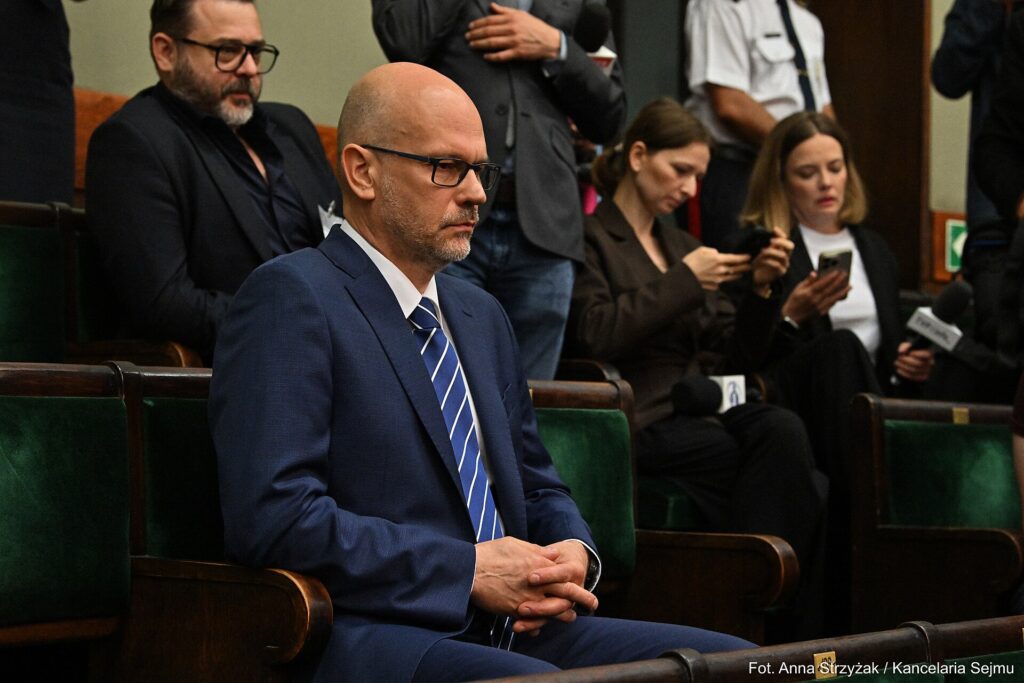
- On October 14, 2026, Maciej Berek, a former minister in the current government of Donald Tusk, read out the oath of a judge of Poland’s Constitutional Tribunal (TK) in the office of the Speaker of the Sejm, Włodzimierz Czarzasty, without the participation of the President of the Republic of Poland.
- The President of the Constitutional Tribunal, Bogdan Święczkowski, did not admit Berek to adjudicate pending a reply from the President of the Republic as to whether he recognizes this oath. The President declared that Berek is not a judge of the Constitutional Tribunal.
- There are growing concerns that the government may attempt to take control of the Tribunal by force: Prime Minister Donald Tusk announced that the Tribunal’s composition would be completed “by all available means,” Justice Minister Waldemar Żurek, asked whether the police should enter the Tribunal and remove its President, replied “If he breaks the law – yes,” and Interior Minister Marcin Kierwiński declared that the police “will intervene” at the Tribunal.
Background: a former minister with disputed qualifications
Since taking power in December 2023, Poland’s ruling coalition led by Prime Minister Donald Tusk has refused to publish the rulings of the Constitutional Tribunal (TK) and has sought to change the Tribunal’s composition by any means available. In March 2026, the Sejm, Poland’s lower house of parliament, elected six new judges to the Tribunal, in a procedure that raised serious doubts as to its compliance with the Sejm’s own Rules of Procedure. The President of the Republic received the oath of two of them, while the remaining four took part in an unlawful “swearing-in” ceremony in the Sejm on April 9, 2026, without the President – before whom, under Polish law, the oath must be taken. As a result, the Tribunal has not admitted them to adjudicate.
On September 4, 2026, the Sejm elected Maciej Berek to the Tribunal to fill the seat of Justice Justyn Piskorski, whose term expired on September 18. Until August 14, 2026, Berek had served as a minister in Donald Tusk’s cabinet, responsible for overseeing the implementation of government policy – and was, in the Prime Minister’s own words, his “right hand.” His nomination openly broke one of the coalition’s flagship promises: a four-year cooling-off period barring former ministers and members of parliament from the Tribunal, which the coalition itself had written into the Constitutional Tribunal Act it passed in 2024 (an act later struck down as unconstitutional on other grounds). Tusk himself admitted that:
some may feel – and do feel – disappointed, because there were supposed to be no former ministers.
Moreover, serious doubts remain as to whether Berek meets the statutory requirements for the office at all: a Tribunal judge must meet the requirements for a judge of the Supreme Court, including at least ten years of practice as an advocate, legal counsel or notary – and the documented periods of Berek’s practice as legal counsel do not appear to reach that threshold.
Instead of dispelling these doubts, the government attacked the President for raising them. Justice Minister and Prosecutor General Waldemar Żurek accused the President’s Chancellery of “breaking the law,” and denied the President any meaningful role in the procedure – contrary to the position taken by the Constitutional Tribunal itself in its judgment of December 3, 2015 (K 34/15), issued before judges elected by the Law and Justice (PiS) majority came to form a majority on the Tribunal. In that judgment, the Tribunal held that the oath taken before the President is not merely a symbolic ceremony but an act with specific legal effects, and that the President may postpone receiving it where it is beyond doubt that the elected person lacks the legal capacity to assume the office of judge.
The stakes go far beyond a single appointment. The government is seeking to install in the Tribunal persons who have not taken the oath before the President and who – like the ruling majority itself – call into question the legitimacy of the Tribunal’s case law of 2016–2024, including landmark rulings affirming the primacy of the Polish Constitution over EU law and, above all, protecting the life of unborn children. At her Sejm hearing, one of the four, Judge Anna Korwin-Piotrowska, suggested that the Tribunal’s 2020 ruling against eugenic abortion might need to be reconsidered and that courts would have to determine whether it “exists in law.”
A substitute “oath” in the Speaker’s office
As we had feared, the government decided to repeat the April performance. On the morning of Wednesday, October 14, 2026, Maciej Berek took an “oath” in the office of the Speaker of the Sejm, Włodzimierz Czarzasty. The ruling camp thus opened yet another chapter in the dispute over the Tribunal – one that, rather than ending it, will only deepen the constitutional crisis.
The event, broadcast by the Chancellery of the Sejm, was described as:
Handing over to Maciej Berek of the Sejm’s resolution on his election to the office of judge of the Constitutional Tribunal.
Judging by this title, one might get the impression that the organizers were ashamed to admit what was really going to take place. And what took place was almost exactly what had happened on April 9, 2026, when four persons elected by the Sejm on March 13 “took the oath” in the Sejm’s Column Hall.
After receiving the resolution, Berek declared that taking the oath was his duty. Then – beginning with the words:
I address the President of the Republic of Poland
– he invoked Article 4(1) of the Act on the Status of Judges of the Constitutional Tribunal and read out the oath. That provision, however, states explicitly:
A person elected to the office of judge of the Tribunal shall take, before the President of the Republic of Poland, an oath worded as follows […].
As we have shown in detail in our analysis, an oath before the President therefore cannot be taken before the Speaker of the Sejm, however solemn the address to the head of state that precedes it. The law knows neither an oath by correspondence nor an oath “at a distance,” and under Article 7 of the Constitution, public authorities act on the basis and within the limits of the law – no provision authorizes the Speaker of the Sejm to take part in receiving the oath of Constitutional Tribunal judges.
After reading the oath, in which a future judge pledges to stand guard over the Constitution, Berek assured that:
we will do everything so that the values referred to in the oath are realized every day in the functioning of the Constitutional Tribunal.
It is hard to imagine a greater display of hypocrisy. A person who begins his tenure as a guardian of the Constitution by ostentatiously bypassing the statutory procedure promises that the values of the oath will be realized every day. Well, on the first day they certainly were not.
The President of the Constitutional Tribunal did not admit Berek to adjudicate
Immediately after the “oath,” Berek, accompanied by the four persons elected by the ruling majority who had “taken the oath” in the Sejm on April 9, went to the seat of the Constitutional Tribunal. In front of the building, a protest was underway against the actions of Donald Tusk’s government and Justice Minister Waldemar Żurek toward the Tribunal. The President of the Tribunal ordered that the arrivals be let onto the Tribunal’s premises and appealed to the protesters to allow the cars through. Nonetheless, scuffles with the police broke out, in which Adam Borowski was injured – an anti-communist opposition activist from the period of communist rule in Poland, who was taken to the hospital.
President of the Tribunal Bogdan Święczkowski invited Berek for a one-on-one conversation in his office. We do not know how it went, but we do know that afterwards all five left the Tribunal’s seat. At a press briefing, the President of the Tribunal announced that he had asked the President of the Republic – Karol Nawrocki – whether he recognized the oath as having been taken before him, and that until a reply was received, Berek would not be admitted to adjudicate. If the President does not recognize the oath, everyone will have to wait for the competence dispute to be resolved.
This refers to the President’s application of April 27, 2026, to resolve a competence dispute between the President and the Sejm (case Kpt 1/26) over whether the power to receive the oath of a person elected by the Sejm as a judge of the Constitutional Tribunal belongs exclusively to the President. It is worth recalling that this solution was proposed by the President of the Ordo Iuris Institute, attorney Jerzy Kwaśniewski – in an Ordo Iuris analysis of March 31, 2026, almost a month before the application was filed. The effects of such a dispute are set out in Article 86(1) of the Act on the Organization of the Constitutional Tribunal and the Mode of Proceedings Before the Constitutional Tribunal:
The institution of proceedings before the Tribunal shall result in the suspension of proceedings before the authorities involved in the competence dispute.
The suspension occurs by operation of law. This means that until a ruling is issued in case Kpt 1/26, neither the President, nor the Sejm, let alone the Speaker of the Sejm, may take any steps related to the oath. Wednesday’s event in the Speaker’s office was therefore doubly unlawful: it took place before the wrong authority, and at a time when no oath could be taken at all.
The President of the Tribunal also revealed that the persons who had not taken the oath before the President attempted to force their way into the judges’ section of the Tribunal. They were, however, prevented from doing so.
The President of the Republic responded to the Tribunal President’s statement that same day. At a press conference with the President of Montenegro, Karol Nawrocki declared:
I do not know before whom Minister Berek swore, but it was certainly not before the President of the Republic of Poland, and if he did not complete this formality – obvious to first-year students – that before the President such an oath takes place at least in the immediate presence of the President, and preferably in the Presidential Palace, because these are the rules of Polish law we have grown accustomed to living by since 1989, then he is certainly not a judge of the Constitutional Tribunal, and the Tribunal will continue to operate in the composition in which it formally, officially, constitutionally […] functions.
It should be recalled that the reason why the former minister Berek has not been invited to take the oath at the Presidential Palace is that, since September, the Chancellery of the President has consistently pointed to unresolved doubts as to whether he meets the requirements of Article 3 of the Act on the Status of Judges of the Constitutional Tribunal, in particular the required length of practice as legal counsel – as the Head of the Chancellery of the President, Zbigniew Bogucki, reiterated just the day before. No one has dispelled these doubts so far – instead, it was decided simply to ignore them.
Late in the afternoon, President Karol Nawrocki himself also arrived at the Tribunal. We do not yet know what he discussed with Tribunal President Święczkowski, but in line with earlier declarations by his Chancellery, we can be certain that he will take all possible lawful measures to defend the Tribunal. Meanwhile, reports were circulating online of larger police forces being concentrated and heading toward central Warsaw. Time will tell whether the government decides on the “forceful option” against the Tribunal – recently announced, after all, by Justice Minister Waldemar Żurek and Interior Minister Marcin Kierwiński.
What the Venice Commission dictated, the government carried out within a day
The timing of the Sejm “oath” is by no means accidental. Exactly one day earlier, the Venice Commission published its opinion CDL-AD(2026)031 on the powers of the President of Poland in the context of the oath-taking of Constitutional Tribunal judges, adopted at its 148th Plenary Session on October 9–10, 2026. In it, the Commission recommended that, where the President refuses or delays receiving the oath, the oath may be taken without his physical participation. The ruling camp implemented this recommendation almost immediately.
The point is that an opinion of the Venice Commission is not a source of law and binds no one – neither the President, nor the Sejm, nor the Constitutional Tribunal. Under Article 1 of its Revised Statute, the Venice Commission is merely an independent consultative body of the Council of Europe, and Poland has never conferred any competences on it by an international agreement – which, under Article 90 of the Polish Constitution, is the only way in which the competences of state authorities may be delegated to an international organization or institution. Moreover, on several key points the opinion misconstrues the Polish legal order. Even so, the Venice Commission saw fit to suggest openly – usurping powers that belong exclusively to the Constitutional Tribunal – that in exceptional circumstances one may disregard the text of the statute and take the oath of a Tribunal judge in writing.
Conclusion
Donald Tusk’s government has once again displayed its hypocrisy. When the Venice Commission’s opinions were inconvenient for it – as when the Commission stated that all Constitutional Tribunal rulings should be published by the government, or warned that judges may not be removed without a court ruling – it simply ignored them, and the non-publication of the Tribunal’s rulings continues to this day. When, however, an opinion suited it, the government implemented it in less than a day.
It is also worth noting that, at least in the view of some legal scholars, Maciej Berek – like the four persons who “took the oath” in the Sejm on April 9 before him – has today effectively resigned from the office of Constitutional Tribunal judge. Treating an oath taken before the Speaker of the Sejm as sufficient to assume the office of judge may be regarded as a refusal to take the oath before the President – and under Article 4(2) of the Act on the Status of Judges of the Constitutional Tribunal, such a refusal is tantamount to resigning from the office.
By taking such steps, the current parliamentary majority is harming itself. It could have elected a politically neutral person who indisputably meets the statutory requirements – in which case the President would have invited that person to take the oath, as he did with Magdalena Bentkowska, Dariusz Szostek and Sławomir Patyra. Instead, it chose a former minister in Donald Tusk’s government whose qualifications are in doubt, and then sent him to take the oath before Speaker Czarzasty. The result is that yet another seat on the Constitutional Tribunal has probably been vacated – an opportunity the next Sejm will no doubt seize.
These events must also be seen in a broader context. In line with its earlier announcements, the government had already set the prosecution service in motion against the Tribunal: on September 23, 2026, the National Prosecutor’s Office – subordinate to Justice Minister and Prosecutor General Waldemar Żurek – charged the Director of the Chancellery of the Constitutional Tribunal and the Commander of the Tribunal Guard with criminal offenses for not admitting to adjudication the persons who had not taken the oath before the President, and barred them from entering the Tribunal building. Concerns that Berek and the other four may ultimately be installed in the Tribunal by force are therefore well founded. What happens next remains to be seen.
Source of cover photo: Wikipedia

