
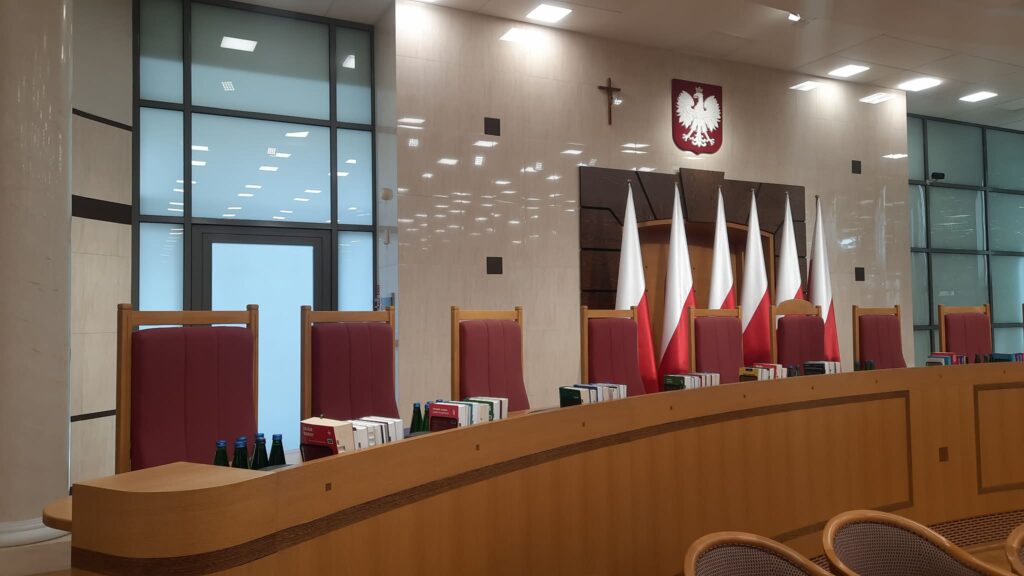
- The dispute over the composition of the Polish Constitutional Tribunal is ongoing, fueled by government pressure aimed at admitting to adjudication 4 persons who have not taken the oath of office before the President of the Republic of Poland.
- This pressure also involves two judges who, having been elected to the Constitutional Tribunal by the current Sejm and having duly taken the oath before the President, subsequently retook it unlawfully before the Speaker of the Sejm. These two judges filed a report with the Prosecutor’s Office alleging that the President of the Constitutional Tribunal may have committed a criminal offense by failing to admit the 4 persons who have not taken the oath to adjudicate. In response, the President of the Constitutional Tribunal reported to the Prosecutor’s Office that the two judges may have filed a false criminal report.
- On May 5, 2026, the European Court of Human Rights issued an interim measure ordering that the 4 persons not be prevented from discharging their duties as Constitutional Tribunal judges. However, this measure was issued defectively – without fulfilling the relevant requirements – and in a case that falls outside the ECtHR’s jurisdiction. Furthermore, interim measures of this type, as they are not provided for in the Convention for the Protection of Human Rights and Fundamental Freedoms, are not legally binding in Polish law.
- On May 22 of this year, all 6 persons elected to the Constitutional Tribunal by the current Sejm demanded, with the backing of Minister of Justice Waldemar Żurek, that the President of the Tribunal convene the Constitutional Tribunal’s General Assembly in order to admit the 4 who had not taken the oath before the President of the Republic of Poland to adjudicate. However, the provisions of the Act on proceedings before the Constitutional Tribunal state clearly that the General Assembly is composed exclusively of sitting judges of the Tribunal who have taken the oath before the President of the Republic of Poland.
On March 13, 2026, the Sejm elected 6 persons as judges of the Constitutional Tribunal. Due to certain doubts regarding the election, as well as proceedings before the Constitutional Tribunal concerning the constitutionality of the procedure for electing these judges, the President of the Republic of Poland administered the oath of office to only 2 of the 6 persons, temporarily refraining from receiving it from the remaining 4. Against this backdrop, all 6 persons – including the 2 who had already taken the oath before the President of the Republic of Poland – on April 9 took an oath de facto before the Speaker of the Sejm, in a manner unknown to Polish law. Following this, the government and organizations aligned with it began exerting pressure on the President of the Constitutional Tribunal to admit the remaining 4 to discharge their duties as Constitutional Tribunal judges, even though, pursuant to Articles 4 and 5 of the Act on the Status of Constitutional Tribunal Judges, the service relationship of a Constitutional Tribunal judge is established upon the taking of the oath before the President of the Republic of Poland.
Mutual Criminal Reports
On April 16, 2026, the President of the Constitutional Tribunal, Bogdan Święczkowski, sent a letter to the Prime Minister – Donald Tusk – appealing for the publication of 67 judgments issued by the Constitutional Tribunal since March 2024, in order to protect the civil liberties and rights of citizens. As we have reported on multiple occasions, Donald Tusk has persistently breached his obligation under Article 21(1)(1) of the Act on the Promulgation of Normative Acts and Certain Other Acts in conjunction with Article 114 of the Act on the Organization and Procedure of Proceedings before the Constitutional Tribunal to publish Constitutional Tribunal judgments – this applies to all judgments, regardless of the bench composition in which they were issued or of who initiated the proceedings. The government refuses to publish judgments issued at the request of the President, a group of opposition MPs, or on the basis of constitutional complaints lodged by ordinary citizens alike. This practice has been expressly held to be impermissible by the Tribunal in its judgment of September 23, 2025 (P 3/25).
The President of the Tribunal noted that since, after 15 months (from December 2024, when the terms of office of Justices Mariusz Muszyński, Piotr Pszczółkowski, and Julia Przyłębska expired) of inaction, the Sejm had finally decided to fill the vacancies on the Tribunal, apparently recognizing that:
The Tribunal is a body that continuously works to uphold the rule of law and protect the rights and freedoms of citizens.”
– then, in order to fully restore its ability to function effectively, the government should also cease the unlawful practice of refusing to publish judgments. This appeal, however, went unanswered.
Instead, two judges – Magdalena Bentkowska and Dariusz Szostek – who had duly taken the oath on April 1 but subsequently retook it before the Speaker of the Sejm on April 9 (thereby exposing themselves to the risk of disciplinary liability under Articles 24 et seq. of the Act on the Status of Constitutional Tribunal Judges for conduct unbecoming the dignity of the office of a Constitutional Tribunal judge, or other unethical conduct that may undermine confidence in their impartiality or independence) – on April 17 filed a report with the Prosecutor’s Office alleging that the President of the Constitutional Tribunal may have committed a criminal offense consisting in:
[…] failing to establish an employment relationship and failing to sign the required documents associated therewith and, consequently, failing to assign them workstations and cases for adjudication
– with respect to the 4 persons who had not taken the oath before the President of the Republic of Poland.
News of this report was promptly disseminated by the Minister of Justice, Waldemar Żurek, who in his characteristic manner began issuing threats directed at the President of the Constitutional Tribunal, tweeting:
Yesterday, a report was filed with the National Prosecutor’s Office concerning the suspected commission of a criminal offense in connection with the obstruction of the work of four duly elected Constitutional Tribunal judges. Neither workstations nor cases were assigned to them. […] The Constitutional Tribunal must be returned to the citizens, not remain a private fiefdom of people accustomed to impunity. The National Prosecutor’s Office is conducting proceedings. We will determine who is responsible for this lawlessness.
The situation in which a Minister – a representative of the executive branch – threatens the President of the Constitutional Tribunal with criminal liability for refusing to take actions contrary to the law (as noted above, a Constitutional Tribunal judge’s service relationship is established upon the taking of the oath before the President of the Republic of Poland, and no one else), should raise very serious concerns from the standpoint of the principle of legality and the principle of separation of powers, including in particular the principle of the independence of the judiciary.
In response to the above report, the President of the Constitutional Tribunal reported to the Prosecutor’s Office that Constitutional Tribunal Justices Magdalena Bentkowska and Dariusz Szostek may have committed the criminal offense referred to in Article 238 of the Polish Criminal Code, namely the filing of a false criminal report. He also indicated that he had commissioned legal analyses regarding the initiation of disciplinary proceedings against them.
The matter was also addressed by Paweł Śliz, MP for Poland 2050 and Chair of the Justice and Human Rights Committee – the same individual who had previously, within the framework of that Committee, clearly obstructed the ability of civil society representatives to participate in the sitting devoted to the selection of candidates for Constitutional Tribunal judgeships. The Chair invited, among others, the President of the Constitutional Tribunal to a sitting of the Committee scheduled for April 28 of this year. The stated purpose of that sitting was to discuss the current situation at the Constitutional Tribunal, summarized under the heading:
ENOUGH of the paralysis at the Constitutional Tribunal.
At this point one may fairly ask: should not ending this paralysis begin with the government’s publication of all outstanding Constitutional Tribunal judgments?
The person invited responded to this invitation by stating that the Sejm has no supervisory powers over the Constitutional Tribunal, and that any genuine concern for its proper functioning should manifest itself first and foremost in the publication and enforcement of its judgments.
The ECtHR Interim Measure
The persons who took the oath on April 9 before the Speaker of the Sejm announced that they would file a complaint with the European Court of Human Rights. On the basis of their application, on May 5 the ECtHR issued an interim measure in which it called upon the Polish government to ensure that the competent domestic authorities (i.e., in practice, the President of the Constitutional Tribunal) did not prevent these 4 persons from discharging their duties as Constitutional Tribunal judges.
This measure was quickly seized upon by Prime Minister Donald Tusk, who stated that:
The European Court of Human Rights has conclusively resolved the matter of the judges of the Constitutional Tribunal elected by the Sejm. The State has an obligation to remove all obstacles preventing them from adjudicating.
The Prime Minister’s position must, however, be regarded as misleading on a number of fronts. First, the European Court did not resolve anything – it merely issued an interim measure. This is an institution provided for under Rule 39 of the Rules of the Court of the ECtHR, pursuant to which:
The Court may, […] in exceptional circumstances […] indicate to the parties any interim measure which it considers should be adopted. Such measures, applicable in cases of imminent risk of irreparable harm to a Convention right, which, on account of its nature, would not be susceptible to reparation, restoration or adequate compensation, may be adopted where necessary in the interests of the parties or the proper conduct of the proceedings.
A careful reading of this provision necessarily gives rise to serious doubts as to whether the conditions set out therein have been met. It refers to an imminent risk of irreparable harm that is incapable of being remedied. But wherein would such harm consist?
One might venture precisely the opposite argument – that it is the admission of these 4 persons to adjudication at the Constitutional Tribunal at this stage that could give rise to such irreparable harm. If such persons were to adjudicate in any case, and subsequently either the Constitutional Tribunal itself or even the ECtHR were to rule that they are not in fact Constitutional Tribunal judges, what would be the legal status of the judgments issued with their participation?
Secondly, the power of the ECtHR to issue interim measures does not derive from any provision of universally binding law. The Convention for the Protection of Human Rights and Fundamental Freedoms – which is the actual source of law referred to in Articles 87 et seq. of the Polish Constitution as a ratified international agreement – makes no mention of them. Interim measures appear solely in the Rules of the European Court of Human Rights, which is a purely internal instrument and therefore produces no legally binding effects within the Polish legal order.
In this context, it should be noted only in passing that the interim measure was addressed to the Polish government – whereas the Constitutional Tribunal, as a body of the judicial branch, is obviously independent from the government, which cannot in any way influence its operations.
Finally, the most important point must be addressed – among the matters in which the ECtHR is empowered to adjudicate under the Convention, no provision can be identified that would authorize it to adjudicate on the status of Constitutional Tribunal judges. Article 6 of the European Convention on Human Rights, which guarantees the right to a fair trial, cannot serve as a basis for this, as it applies only to disputes of a civil or criminal nature. The question of holding the office of a Constitutional Tribunal judge is not such a dispute – a point that was correctly and unequivocally affirmed by the Supreme Court in its ruling of November 5, 2009, I CSK 16/09.
The Constitutional Tribunal also responded to the measure, issuing an official statement which, in addition to recalling that:
[…] it falls outside the jurisdiction of the European Court of Human Rights to adjudicate on the constitutional order of the constitutional organs of the Republic of Poland or to discharge the functions of a labor court.
– also stressed that another requirement established in the Convention, specifically in Article 35, had not been met: the exhaustion of domestic remedies.
This argument may be supplemented by noting that another requirement referred to in Article 35 had also not been met – namely, the required period of four months from the date of the final decision had not yet elapsed. Even counting this period in the manner most favorable to the applicants – from the date of the Sejm election – it would not expire until July 13. It seems, however, that the final decision should rather be taken to be the Constitutional Tribunal’s judgment in case Kpt 1/26 concerning the jurisdictional dispute between the President and the Sejm over whether the power to administer the oath to a person elected by the Sejm to the position of Constitutional Tribunal judge belongs exclusively to the President of the Republic of Poland, which, as is known, has not yet been issued.
The President of the Constitutional Tribunal also transmitted, at the request of the Ministry of Foreign Affairs, his statement on the proceedings before the ECtHR, in which he emphasized that:
The President of the Tribunal […] is not obstructing the applicants’ assumption and discharge of judicial duties, since they are not Constitutional Tribunal judges. They were elected to the position of Constitutional Tribunal judge, but their service relationship has not been established, and they have not assumed their duties, due to the fact that they did not take the oath before the President of the Republic of Poland, as required by the Act on the Status of Constitutional Tribunal Judges.
He again underscored that:
The European Court of Human Rights – in accordance with the Constitution and the established case law of the Constitutional Tribunal – does not have formal competence to assess the legality of the election of Constitutional Tribunal judges. It has not been vested with such authority under any provision of the Convention for the Protection of Human Rights and Fundamental Freedoms. The ECtHR’s adjudication in this matter is therefore devoid of enforceability.
Further Actions and Statements by the Persons Elected by the Sejm
In the meantime, both judges who took the oath on April 1, 2026 (Magdalena Bentkowska and Dariusz Szostek) announced that they would not adjudicate in panels that include Justices Jarosław Wyrembak and Justyn Piskorski (elected to the seats previously occupied by Henryk Cioch and Lech Morawski, who had in turn been elected to seats to which the VIII Sejm, which triggered the crisis concerning the Constitutional Tribunal, had earlier made its own appointments). By doing so, Magdalena Bentkowska and Dariusz Szostek expose themselves to the risk of disciplinary liability on an additional ground – refusal to discharge their duties.
Both of the aforementioned judges, as well as the 4 persons elected as judges who had not taken the oath, filed an application with the President of the Constitutional Tribunal for the convening of the Constitutional Tribunal’s General Assembly. The applicants demanded:
[…] resolution of the constitutional crisis caused by the failure to admit the duly elected Constitutional Tribunal judges to adjudication.
Unsurprisingly, their application was backed by the Minister of Justice, Waldemar Żurek, who reportedly commented:
This is the right move. The acting President of the Constitutional Tribunal is running the Tribunal as a private fiefdom. He is breaking the law.
The fact of the matter, however, is that as clearly stated in Article 6(1) of the Act on the Organization and Procedure of Proceedings before the Constitutional Tribunal:
The General Assembly shall be composed of sitting judges of the Tribunal who have taken the oath before the President of the Republic of Poland.
It follows, plainly and obviously, that the convening of a General Assembly with the participation of the 4 persons elected by the Sejm who have not taken the oath before the President is not possible.
The most recent act of interference with the Tribunal’s autonomy was the incursion on May 20 by 13 of the 15 members of the National Council of the Judiciary elected from among judges for the new term into the Tribunal’s premises, who attempted to force the organization of a meeting with the 4 persons elected as judges who had not taken the oath before the President.
The NCJ members were, however, informed by the Constitutional Tribunal spokesperson that it was not possible to organize a meeting without a prior appointment:
If you wish to meet with them, I see no problem. However, you have not received permission to hold meetings on the premises of the Tribunal. You would need to make a specific appointment, and I encourage you to do so. We will then designate a day and time for you, and you will be warmly welcomed at the Tribunal’s premises.
The Constitutional Tribunal issued an official statement on the matter, in which it once again recalled that:
Persons elected by the Sejm as Constitutional Tribunal judges […] have not assumed their duties, as they have not taken the oath before the President of the Republic of Poland.
It was noted that those persons:
[…] may for the time being be present at the Tribunal’s premises and are received there on each occasion. However, they are not authorized to hold meetings on Tribunal premises with outside guests invited by themselves.”
Finally, it was emphasized that:
The National Council of the Judiciary, which the persons attempting to enter the Constitutional Tribunal’s premises purported to represent, does not have authority to supervise or oversee the work of the Constitutional Tribunal.
Summary
Both the aforementioned prosecutorial proceedings and the proceedings before the Constitutional Tribunal concerning the jurisdictional dispute are still ongoing. With respect to the former, the President of the Constitutional Tribunal was heard on May 25, 2026 as the reporting party and representative of the aggrieved institution.
It seems therefore that, at least in particular until the conclusion of the proceedings before the Constitutional Tribunal, the government should refrain from exerting any pressure on the Constitutional Tribunal aimed at admitting to adjudication persons who have not taken the oath before the President of the Republic of Poland. That these persons have failed to fulfill the obligation incumbent upon them should be beyond doubt – all the more so in light of the recent judgment in case K 3/26.
As for the two judges who took the correct oath but subsequently began supporting the above pressure and participated in the unlawful, repeated oath before the Speaker of the Sejm (thereby in effect calling their own status into question), they must reckon with the risk of disciplinary liability for conduct unbecoming the dignity of the office of a Constitutional Tribunal judge – particularly in light of their declarations that they would not adjudicate together with certain other Constitutional Tribunal judges.
