
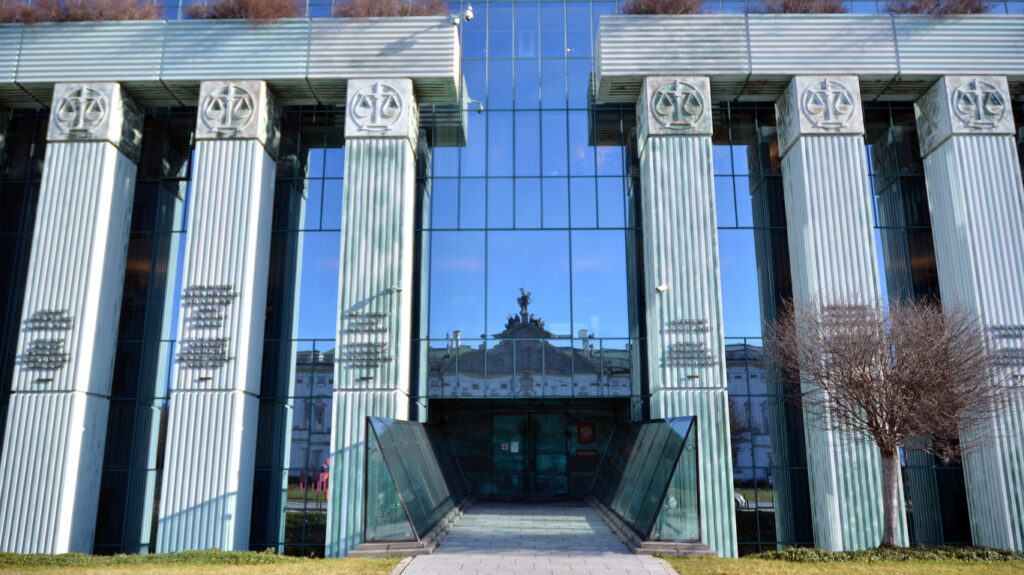
- In response to an appeal filed by their counsel, Poland’s Supreme Court set aside both orders issued by Anna Korwin-Piotrowska on October 30, 2026, imposing an immediate break in the official duties of the legitimate President of Poland’s Constitutional Tribunal (CT), Bogdan Święczkowski, and of its Vice-President, Bartłomiej Sochański.
- The appellants had asked for the orders to be recognized as non-existent acts, issued by a person manifestly lacking authority.
- Despite the ruling, the police are still not letting President Święczkowski into the CT. Officers who do not wish to take part in lawlessness, and to face negative consequences for it in the future, should nevertheless comply with the ruling.
On October 30, 2026, Judge Anna Korwin-Piotrowska issued two orders imposing an immediate, one-month break in the official duties of the legitimate President of Poland’s Constitutional Tribunal (CT), Bogdan Święczkowski, and of CT Vice-President Bartłomiej Sochański, while styling herself as the person “directing the work” of the CT. As we have already written, the orders were manifestly invalid, having been issued not only by an unauthorized person but also under an impermissible procedure. Nevertheless, the police complied with them, barring the President from the CT’s premises.
On behalf of the President and Vice-President, attorney Michał Skwarzyński appealed both orders to Poland’s Supreme Court, requesting, among other things:
a finding that the orders constitute so-called non-acts [legally non-existent acts], i.e., actions simulating the issuance of an effective authoritative act despite the absence of the necessary competence on the part of the person issuing them and of the substantive conditions for applying the measure provided for in Art. 130 § 1 of the Law on the System of Common Courts.
As the Supreme Court announced, on November 10, 2026, the Court upheld the appeal and set aside both orders (case no. II ZZ 3/26). The written grounds are not yet known, but the final decision must be regarded as entirely correct – for at least two reasons.
A disciplinary case concerning a common-court judge, not a dispute over the Tribunal
The decision was reached in two steps. On November 6, Supreme Court Judge Zbigniew Korzeniowski held that the jurisdiction of the Polish Supreme Court’s Chamber of Professional Responsibility does not extend to CT judges, and referred the case to the Tribunal as a separate organ of judicial power. On November 10, however, the Supreme Court set aside that decision (case no. II ZO 178/26), and the Chamber set aside both orders the very same day.
The thesis that the Chamber’s jurisdiction does not extend to CT judges is, incidentally, correct. The point, however, is that Korwin-Piotrowska’s orders expressly invoked Art. 130 § 1 of the Law on the System of Common Courts, which provides for an immediate break in the official duties of a common-court judge. That provision obviously does not apply to CT judges, as we have written – yet the review of acts issued under it falls to the Supreme Court. Under Art. 27a § 1(1)(b) of the Act on the Supreme Court, the Chamber of Professional Responsibility has jurisdiction over cases heard by the Supreme Court in connection with disciplinary proceedings conducted under the Law on the System of Common Courts. Indeed, this Chamber routinely reviews orders issued under Art. 130 § 1 – including those issued by Justice Minister Waldemar Żurek (unlawfully, incidentally, without the statutory conditions being met, as we have written). Since Korwin-Piotrowska herself resorted to the procedure provided for common-court judges, it is hardly surprising that the review of her decision ended up before the Supreme Court. What should be considered unacceptable, by contrast, is the logic she applies, under which the Law on the System of Common Courts may be applied to CT judges when this suits her, but not when it does not.
Korwin-Piotrowska is still a judge of the Regional Court in Opole
The second argument concerns the person involved. Although Korwin-Piotrowska read out the oath of a CT judge on April 9, 2026, in the presence of the Speaker of the Sejm, Poland’s lower house of parliament, she has to this day not taken it before the President of the Republic of Poland, as required by Art. 4(1) of the Act on the Status of Judges of the Constitutional Tribunal. Meanwhile, Art. 5 of that Act leaves no doubt:
The service relationship of a judge of the Tribunal is established upon taking the oath.
As early as its judgment of December 3, 2015 (K 34/15), the CT stressed that the oath:
is not merely a solemn ceremony that is symbolic in character, and that until it has been taken, the judicial vacancies were not yet filled.
Korwin-Piotrowska has therefore not taken up office at the Tribunal. Importantly, she has so far not expressly resigned from her previous position – that of a judge of the Regional Court in Opole. Unlike former judge Krystian Markiewicz, who expressly resigned from the office of judge of the Regional Court in Katowice after being elected to the position of judge of the Constitutional Court by the Sejm, Korwin-Piotrowska merely provided the Minister of Justice with an assurance that:
the position of judge of the Regional Court in Opole has been implicitly extinguished and, in a technical and organizational sense, transformed into the position of a judge of the Constitutional Tribunal.
– while expressly declaring that she does not intend:
to submit a declaration of resignation from office.
Even if such a construction were deemed admissible, its conditions have not been met – since, as we have repeatedly pointed out, Korwin-Piotrowska has not become a CT judge for lack of an oath before the President of the Republic. This means that, in the eyes of Polish law, she remains a judge of the Regional Court in Opole, and her actions also fall within the Supreme Court’s jurisdiction by reason of her status: as a common-court judge, she is subject to disciplinary liability under Art. 107 § 1 of the Law on the System of Common Courts, and cases heard by the Supreme Court in this procedure fall – as indicated above – to the Chamber of Professional Responsibility.
Neither the appeal to the Supreme Court nor its ruling means recognizing the orders as effective
From a doctrinal point of view, one may consider whether the Supreme Court’s decision was the most fortunate one as regards the procedural aspects of the case.
It might have been more appropriate for the Supreme Court to leave the appeal unexamined (Art. 430 § 1 of the Code of Criminal Procedure in conjunction with Art. 128 of the Law on the System of Common Courts), finding that the orders are non-existent acts and, as such, not only produce no effects whatsoever, but cannot even be subject to review by the Supreme Court or any other court. In other words, under such an interpretation, the Supreme Court could have refused to set aside the orders, finding instead that since both acts never existed in the first place, there is nothing to set aside.
One may doubt, however, whether – given the current situation and the potential consequences of precisely such a ruling – this would have been the best solution from the standpoint of protecting the law. The authorities and the media sympathetic to them would probably have immediately proclaimed such a decision a success, stressing that “the court dismissed the appeal” while passing over in silence the reason why. Meanwhile, the orders, although invalid, unfortunately produce real effects: it is on their basis that, since early November, the police have been refusing to let President Święczkowski into the Tribunal.
Perhaps, then – bearing the above context in mind – what was needed was a ruling on the merits, stating in detail, in the operative part itself, that we are dealing with lawlessness whose effects must be reversed immediately.
The government has, in fact, already tried to exploit the complicated legal situation – including the procedural doubts mentioned above – to manipulate public opinion. Right after the first-instance decision of November 6, Minister Waldemar Żurek argued that since President Święczkowski and Vice-President Sochański had filed appeals, they had:
recognized the procedure under Art. 130 § 1 of the [Law on the System of Common Courts] and the effectiveness of the break in their official duties.
According to the minister, Judge Korzeniowski’s decision at the same time:
fully confirms our position.
In reality, however, this reasoning is completely misguided. First, as follows from the request quoted at the outset, the appellants sought to have the orders recognized as non-existent acts, and were therefore guided by premises entirely opposite to those the minister attributes to them. Challenging an act that the authorities enforce by force is elementary procedural caution, not an admission of its legal force.
Second, the decision in which the minister saw confirmation of his position – which, incidentally, survived a mere four days – likewise in no way prejudged the effectiveness of the orders in question; it merely held – not without grounds, as we have indicated above – that the Supreme Court lacked jurisdiction in this case. If anything, it can be read as a suggestion that Art. 130 of the Law on the System of Common Courts does not apply to CT judges – that is, precisely as yet another refutation of the minister’s position.
Conclusion
We harbor no illusions that the government of Donald Tusk and the police subordinate to it will respect the ruling issued by the Supreme Court. One should rather fear that, in the coming days, the Supreme Court itself may become yet another target of the ruling camp’s unlawful, forcible actions.
For now, on November 12, Constitutional Tribunal President Święczkowski – together with Vice-President Sochański and Judges Stanisław Piotrowicz and Jarosław Wyrembak – appeared with the Supreme Court’s decision in front of the Tribunal’s gate, demanding to be admitted to the seat of the body he heads. The police, however, did not allow this, and the commanding officer who was summoned did not even show up to receive the ruling, which was eventually affixed to the gate. The President is now considering further steps, including entering with the assistance of a court bailiff.
Notwithstanding these facts, the ruling is of considerable significance. First, it is yet another argument for rank-and-file police officers who – acting in line with what we encourage in the Ordo Iuris guide for officers we have just published – would like to refuse to take part in carrying out unlawful orders concerning the blockade of the CT’s seat. Second, an independent court will also have to take it into account when ruling on the criminal liability of members of Prime Minister Donald Tusk’s government and the services subordinate to it for the crime of a coup d’état under Art. 128 of the Criminal Code – which, we believe, will happen as soon as the current government, after the next elections, loses its control over the prosecution service that it has unlawfully seized.
Image source: iStock.
