
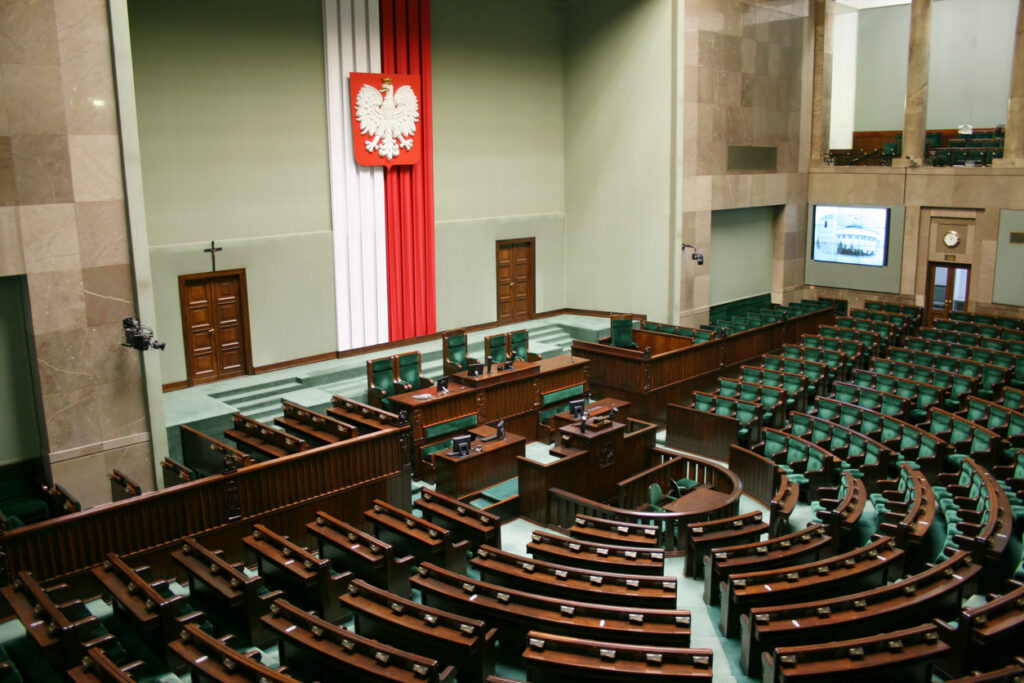
- On June 11, the Sejm majority (the Sejm being Poland’s lower house of parliament) elected Sławomir Patyra as a judge of the Constitutional Tribunal. He is the author of one of the legal opinions on the basis of which Adam Bodnar, in early 2024, unlawfully deprived National Prosecutor Dariusz Barski of the ability to perform his duties.
- On June 24, the Regional Court in Warsaw overturned the prosecution’s decision to discontinue the investigation into the assault on the National Prosecutor’s Office and ordered an examination of the role of the legal opinions issued in that matter.
- Until the matter is clarified, the President of the Republic of Poland should refrain from accepting the oath of office from Sławomir Patyra.
- June 24 was also to have seen a sitting of the General Assembly of Constitutional Tribunal judges, which was, however, prevented by the entry into the chamber of unauthorized individuals – Krystian Markiewicz and Marcin Dziurda.
On June 11, 2026, the Sejm – by the votes of 235 members, mainly from the current governing coalition – elected Sławomir Patyra, a habilitated doctor of law (dr hab.), as a judge of the Constitutional Tribunal (TK), Poland’s constitutional court. This election raised fewer doubts than the one carried out on March 13 of this year – in particular, there was no unjustified delay in holding the vote and thus no breach of the time limits laid down in the Rules of Procedure of the Sejm. This does not mean, however, that the election took place without any controversy at all – even before it was held, serious reservations about the candidate were being voiced.
In particular, in a press interview given on May 26, 2026, he called on those in power to take even more resolute action to admit to adjudication at the Constitutional Tribunal persons who had not taken the oath before the President of the Republic of Poland. In doing so, he suggested that if he himself were not admitted to adjudicate, then police intervention would be permissible, or even necessary:
If a public official openly breaks the law, then the police have the right to step in.
Meanwhile, as we have reported on many occasions, in light of Article 5 of the Act on the Status of Constitutional Tribunal Judges and the Tribunal’s consistent line of jurisprudence, exactly the opposite is true – allowing persons who have not taken the oath before the President of the Republic of Poland to sit in judgement would constitute a clear breach of the law.
The above press statement is not, however, the most important reservation that can be raised against the person elected by the Sejm. That most important reservation became particularly apparent just a few days after the election.
Overturning of the decision to discontinue the investigation into the assault on the National Prosecutor’s Office
On June 24 of this year, the Regional Court in Warsaw overturned the decision of the Regional Prosecutor’s Office in Radom to discontinue the investigation into the assault on the National Prosecutor’s Office, carried out on January 12, 2024. Let us recall – on that day, the then Minister of Justice–Prosecutor General Adam Bodnar, without citing any legal basis whatsoever, handed the National Prosecutor, Dariusz Barski, a document stating that his reinstatement to active service on February 16, 2022 by the previous Prosecutor General, Zbigniew Ziobro, had been carried out in breach of the applicable regulations and had produced no legal effect. Such an action was intended to circumvent Article 14 of the Law on the Public Prosecutor’s Office, under which the National Prosecutor may be dismissed only with the consent of the President of the Republic of Poland. On January 24, 2024, meanwhile, there occurred the physical takeover of Prosecutor Barski’s office, in the presence of Minister Bodnar and with the assistance of Prison Service officers.
Minister Bodnar’s action was found to be contrary to law by the Supreme Court in its resolution of September 27, 2024 (ref. I KZP 3/24), and by the Constitutional Tribunal in its judgment of November 22, 2024 (ref. SK 13/24).
It is therefore not surprising that this action was reported to the prosecution service in connection with a suspicion of the commission of an offense under Article 258 of the Criminal Code (an organized criminal group) and Article 231(1) of the Criminal Code (abuse of power). The prosecution, however, swiftly discontinued the proceedings, without even questioning any of the key witnesses, foremost among them Prosecutor Barski.
This ruling was, however, appealed, and the Regional Court in Warsaw overturned it, ordering the prosecution to examine the allegations thoroughly.
What is especially important is that, as noted by counsel for one of the injured parties, attorney Dr. Michał Skwarzyński:
The court ordered that proceedings be conducted with a view to the accounts of the minister and the prime minister, as well as to examining whether there was pressure on the prosecutors conducting the proceedings, and how the matter of commissioning the opinions looked.
Why is this important, and how does it relate to the Sejm’s election of Sławomir Patyra as a Constitutional Tribunal judge? Well, Sławomir Patyra was – as the Ministry of Justice openly announced on its website – the author of one of those very opinions on the basis of which Minister Bodnar unlawfully deprived National Prosecutor Dariusz Barski of the ability to perform his duties.
In this context, the question must therefore be asked – does Sławomir Patyra meet the requirements for holding the office of a Constitutional Tribunal judge set out in Article 3 of the Act on the Status of Constitutional Tribunal Judges in conjunction with Article 30 of the Act on the Supreme Court, that is:
- is he of unblemished character;
- and does he distinguish himself by a high level of legal knowledge?
The legal association “Veritas et Ius in Service to the Nation” prepared an analysis on this matter, in which it indicates that the President of the Republic of Poland is fully entitled – or indeed obliged – in this situation to refrain from accepting the oath, at least until the investigation is concluded.
Undoubtedly, the possibility of refraining from accepting the oath in the event of special circumstances was clearly signaled by the Constitutional Tribunal in its well-known judgment in case K 34/15. The Tribunal came out even more unequivocally in favor of it in more recent case K 3/26.
Such an action was, moreover, consistent with the precedent set by the case of Judge Lidia Bagińska. She was elected to the Constitutional Tribunal by the Sejm on December 8, 2006, but took the oath only on March 6, 2007. The decision to delay, taken by the then President of the Republic, Lech Kaczyński, resulted from the fact that a few days after Lidia Bagińska’s election the District Court for Warsaw ruled to remove her from the office of receiver on account of her failure to comply with the recommendations of the judge-commissioner and of having misled the court. Professor Piotr Winczorek described this fact as resulting in Lidia Bagińska losing her:
moral qualifications to hold the office
– while also emphasizing, however, that until she takes the oath before the President she:
is not yet fully a judge.
Of course, in the case of Sławomir Patyra, so far there has been not only no issuance of any ruling, even a non-final one, but not even the bringing of charges against anyone. It should however be borne in mind that the matter itself concerns a considerably more serious subject – an assault on a key organ of the state.
For this reason, one must agree that, until this matter is clarified – or at least until the involvement in it of the person elected by the Sejm to the Constitutional Tribunal is clarified – the President of the Republic of Poland should refrain from accepting the oath. This does not, of course, mean that it is already possible at this stage to state unequivocally whether the President should accept the oath from that person at all. What seems crucial here is the outcome of the investigation, or perhaps even more so any further decisions of the court. Moreover, the full statement of reasons for the judgment in the aforementioned case K 3/26 has still not been published; in it, the Tribunal may perhaps elaborate on which extraordinary, objective and indisputable situations authorize the President to refrain permanently from accepting the oath. If it does not, then it may be worthwhile for the President of the Republic of Poland to turn once again to the Constitutional Tribunal in this matter, with an application aimed at describing more precisely those grounds and the procedure the President should follow in such a situation.
Attempted entry of unauthorized individuals into the Constitutional Tribunal’s General Assembly
The above issue is not the only controversy concerning the Constitutional Tribunal that has arisen recently on the part of the governing majority and its nominees. On June 24, 2026, a General Assembly of the Judges of the Constitutional Tribunal was to have taken place which, according to a communiqué from the President of the Constitutional Tribunal:
did not take place due to a lack of quorum. Despite being physically present at the Constitutional Tribunal, two judges – Magdalena Bentkowska and Dariusz Szostek – did not sign the attendance list.
The judges concerned responded to the communiqué, claiming that they had every intention of signing but that this had been made impossible for them.
On that occasion, however, they admitted that Krystian Markiewicz and Marcin Dziurda had attempted to take part in the General Assembly – that is, persons who, on account of not having taken the oath before the President of the Republic of Poland, had not assumed the office of Constitutional Tribunal judge. It appears that it was precisely the attempt by these persons to participate in the General Assembly that was the main reason for its cancellation by the President of the Constitutional Tribunal, which was, moreover, acknowledged in a further communiqué from the Constitutional Tribunal.
In it, the President of the Constitutional Tribunal indicated that these persons had allegedly been brought into the chamber by Constitutional Tribunal judges Magdalena Bentkowska and Dariusz Szostek, after which, despite being called upon three times to leave it, they failed to comply, making it impossible to conduct the sitting.
Judges Bentkowska and Szostek again responded to the above communiqué, claiming that they had by no means let Krystian Markiewicz or Marcin Dziurda into the chamber, but admitting that the latter – on their own initiative, unstopped by the Tribunal’s guard – had in fact entered the chamber.
It should be recalled here once again that, pursuant to Article 6(1) of the Act on the Organization and Mode of Proceedings before the Constitutional Tribunal:
The General Assembly shall be composed of sitting judges of the Tribunal who have taken the oath before the President of the Republic of Poland.
Given that – as we have already reported – persons elected as Constitutional Tribunal judges but who had not taken the oath had previously declared their willingness to take part in the General Assembly, it can be surmised that they regarded this as a way of confirming their status. It is therefore all the less surprising that the President of the Constitutional Tribunal could not allow them to participate in that sitting.
Summary
Whatever those currently in power may do it must be emphasized once again that persons who were elected by the Sejm but who have not taken the oath before the President of the Republic of Poland cannot exercise the mandate of a Constitutional Tribunal judge.
What is more – with respect to such persons the President, in carrying out the task entrusted to him under Article 126(2) of the Constitution, according to which:
The President of the Republic shall ensure observance of the Constitution,
– may, and sometimes even should, refrain from accepting the oath if there are doubts as to whether these persons meet the statutory requirements for holding the office of a Constitutional Tribunal judge. The actions taken by the persons elected by the Sejm, both in March and in June of this year, can undoubtedly be regarded as giving grounds for precisely such doubts.
Source of cover photo: iStock.
