
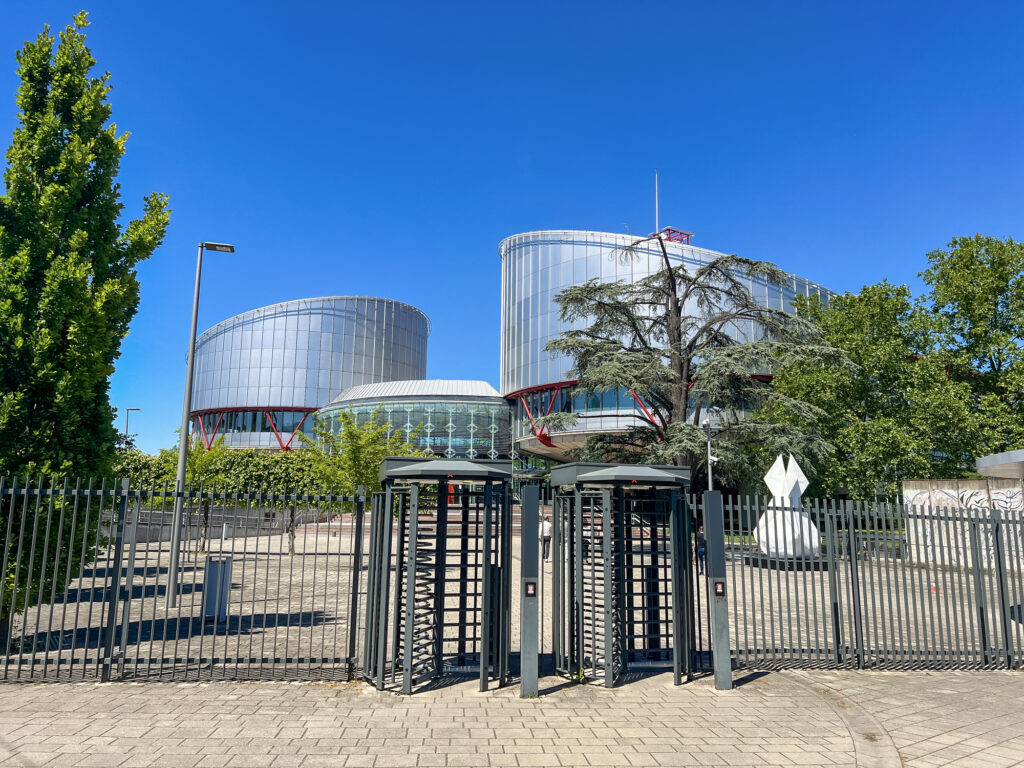
- In a letter of August 11, 2026, Poland’s Ministry of Justice admitted that the European Court of Human Rights (ECtHR) has never issued a single judgment finding a violation of the right to a court because a common court judge appointed on the motion of the National Council of the Judiciary (NCJ), as reshaped in 2018, sat on the bench.
- Yet for more than a year, Justice Minister Waldemar Żurek has been announcing that judges appointed since 2018 will pay out of their own pocket for compensation allegedly awarded by the ECtHR, while his ministry speaks of a hundred cases lost in Strasbourg.
- In reality, money reaches the applicants almost exclusively because the Polish government itself – in friendly settlements and unilateral declarations – admits to violations of the Convention and offers compensation.
- A government that first pays voluntarily and then announces it will shift the costs onto the judges has no grounds to demand recourse from those judges. Responsibility for the purposefulness of these expenditures lies with those who decide on them – which raises questions of public finance discipline.
Since 2018, Polish judges have been appointed by the President of the Republic on the motion of the National Council of the Judiciary (NCJ), whose judge-members – following the 2017 reform – are elected by the Sejm, Poland’s lower house of parliament. Poland’s Constitutional Tribunal held this model to be consistent with the Constitution as early as its judgment of March 25, 2019 (ref. K 12/18). Nevertheless, the coalition led by Donald Tusk, which took power in December 2023, has been treating the thousands of judges appointed under this procedure as “defective,” relying on the case law of two European courts. The European Court of Human Rights (ECtHR) – most notably in its pilot judgment in Wałęsa v. Poland of November 23, 2023 – and the Court of Justice of the European Union (CJEU) – most recently in its rulings of September 4, 2025 and March 24, 2026 – have taken it upon themselves to assess the procedure by which Polish judges are appointed and to conclude that benches including such judges may fail to meet the standard of a “tribunal established by law.”
The actions of both European courts thus constitute a usurpation of competences that Poland has never conferred on either court. Under Article 179 of the Polish Constitution, judges are appointed by the President of the Republic on the motion of the NCJ, and neither the European Convention on Human Rights nor the EU Treaties authorize Strasbourg or Luxembourg to review the effectiveness of such appointments. The Constitutional Tribunal confirmed this in its judgment of March 10, 2022 (ref. K 7/21), holding Article 6(1) of the Convention unconstitutional insofar as it allows the ECtHR to create norms on the appointment of national judges and to review the constitutionality of Polish laws on the judiciary and the NCJ, and – with respect to the CJEU – in its judgment of September 10, 2026 (ref. P 10/24).
The conflict with both European courts is therefore a fact. Poland’s Ministry of Justice, however, not only ignores the Constitutional Tribunal’s case law finding that these courts have exceeded their competences, but also misleads the public about what the two courts have actually held and what this would mean for the status of the judges concerned – proposing solutions that not even Strasbourg or Luxembourg would ever endorse, such as the mass removal of judges from office by statute. In particular, government ministers have suggested that every time a judge appointed since 2018 hears a case, Poland ends up paying millions because of the many cases it supposedly loses in Strasbourg. The reality is quite different.
Zero Strasbourg rulings concerning common court judges – the ministry’s own admission
On October 13, 2026, the Nationwide Association of Judges “Aequitas” disclosed the reply of Poland’s Ministry of Justice to its request for access to public information. The association had asked the ministry about all judgments and decisions of the ECtHR finding a violation of Article 6(1) of the Convention for the Protection of Human Rights and Fundamental Freedoms because a common or military court judge appointed on the motion of the NCJ, as shaped by the Act of December 8, 2017, sat on the bench – including cases ended by a friendly settlement or a unilateral declaration of the government. In its letter of August 11, 2026 (ref. DWMPC-VIII.0820.2.2026), the ministry replied:
[…] in its case law to date, the European Court of Human Rights […] has not issued any judgment or decision in connection with a finding by the Court of a violation of a party’s right to a tribunal established by law (independent and impartial) within the meaning of Article 6(1) of the Convention […] on account of the participation in the bench of a person appointed to the office of judge in a common or military court on the motion of the National Council of the Judiciary as shaped in the manner laid down in the Act of December 8, 2017 […].
In other words, according to the official position of the ministry itself, as of August 11, 2026, there was not a single ECtHR ruling that could justify the announced recourse lawsuits against common court judges. “Aequitas” therefore rightly asks whether the repeated threats of financial liability were merely a political bluff:
Were they meant to produce a chilling effect and to stoke public hostility toward a particular group of judges?
For more than a year, Minister Żurek has been threatening judges that they will pay out of their own pocket
The ministry’s reply is worth setting against what the minister himself has been saying. On September 4, 2025, commenting on the CJEU judgment in case C-225/22 issued that same day – in which the Court held that a national court may treat as non-existent a decision of the Supreme Court’s Chamber of Extraordinary Control and Public Affairs issued by a bench failing to meet EU requirements of independence and impartiality, a judgment itself delivered in manifest excess of competence, as we have already pointed out – Waldemar Żurek announced:
Those who put on judicial robes, even though they know they are not a court, and because of whose actions Poland has to pay compensation, will have to cover those costs out of their own pocket.
In a video published by the ministry, he added:
The Supreme Court building is still occupied by persons who do not have the status of a court, and we have to pay compensation on their account. But this has to end.
A few days later, on September 18, 2025, the minister – who in Poland also serves as Prosecutor General – announced the creation of a team of prosecutors to take part in proceedings which, in his view, expose the State Treasury to compensation claims. Then, as we reported, he sent letters to the Supreme Court and Supreme Administrative Court (NSA) calling on judges appointed since 2018 to stop adjudicating, under threat of financial and even criminal consequences. In a radio interview on September 29, 2025, the minister set out his plan quite openly:
[…] first we will appeal, then we will file recourse lawsuits.
The same narrative runs through the ministry’s official reply of March 1, 2026, to parliamentary question no. 15030, in which Deputy Minister Dariusz Mazur stated:
In addition, Poland has already paid approximately PLN 5 million in compensation in 100 cases lost before the ECtHR. A further 1,000 proceedings are currently pending before the ECtHR, which generates a risk of paying an additional PLN 50 million.
The government’s allies have also fueled the atmosphere. As early as April 2025, the Polish Judges’ Association “Iustitia,” which makes no secret of its support for the government, called for judges appointed since 2018 to reimburse the State Treasury for settlements concluded by Poland before the ECtHR – as we reported, citing numerous experts who questioned the lawfulness of such a solution. Indeed, it is hard to see how the conditions for a recourse claim under Article 441 § 3 of the Civil Code, invoked by supporters of recourse, could be met at all:
Whoever has redressed damage for which he is liable despite the absence of fault shall have a recourse claim against the perpetrator if the damage was caused through the perpetrator’s fault.
Adjudication by judges appointed by the President of the Republic on the motion of an NCJ formed under a statute that has never been struck down by the Constitutional Tribunal – and that the Tribunal expressly upheld in the K 12/18 judgment – cannot be deemed unlawful. Still less can these judges be found at fault, whether intentionally or even negligently, since they acted on the basis of an act of appointment issued by the head of state.
Against this background, the reply given to “Aequitas” is of fundamental importance. Common and military court judges make up the overwhelming majority of the judges appointed since 2018. It is precisely they who have been hearing for months that their adjudication exposes the State Treasury to compensation claims. Yet, according to the ministry itself, there is not a single ECtHR ruling – neither a judgment nor a decision striking out an application after a settlement or a government declaration – concerning their participation in a bench. Announcements of recourse against them were therefore devoid of any foundation, even by the government’s own logic.
It is not Strasbourg that awards compensation – the government itself admits violations and pays
One day before disclosing the ministry’s reply, on October 12, 2026, “Aequitas” exposed the mechanism on which the government’s entire narrative of costs running into millions rests, using the example of Leszczyńska-Furtak and Others v. Poland (applications nos. 39471/22, 39477/22 and 44068/22). The applicants were three judges of the Court of Appeal in Warsaw – Ewa Leszczyńska-Furtak, Marzanna Piekarska-Drążek and Ewa Gregajtys – who in 2022 had been transferred from the criminal division to the labor and social insurance division. In the media and among judges aligned with the ruling camp, the claim spread that the ECtHR had awarded them nearly PLN 300,000, while OKO.press provocatively wrote:
The compensation, amounting to as much as PLN 300,000, will not be paid by Schab and Radzik, however, but by all citizens.
The facts, however, are entirely different:
In the case of Leszczyńska-Furtak and Others v. Poland (applications nos. 39471/22, 39477/22 and 44068/22), @PremierRP acknowledged a violation of Article 6(1) and Article 8 of the ECHR and undertook to pay EUR 19,500 to each applicant (EUR 58,500 in total), covering pecuniary and non-pecuniary damage and costs. […] This means that it was not the Court that “ruled,” “found,” “granted” or “awarded.”
The Court did not even receive the applicants’ reply as to whether they accepted the terms of the declaration. It merely found that the amounts proposed by the government were consistent with those awarded in similar cases and struck the applications out under Article 37(1)(c) of the Convention, which reads:
The Court may at any stage of the proceedings decide to strike an application out of its list of cases where the circumstances lead to the conclusion that […] (c) for any other reason established by the Court, it is no longer justified to continue the examination of the application.
As “Aequitas” aptly observes, this is the equivalent of the discontinuance of civil proceedings following a settlement between the parties. Strasbourg thus did not examine on the merits whether the Convention had been violated at all, let alone attribute responsibility to any judge. The violation was acknowledged solely by Donald Tusk’s government, which undertook to pay for it.
Nor is this an isolated case. As early as November 2024, the ECtHR struck out 22 applications concerning adjudication by judges appointed since 2018 – 20 of them after friendly settlements and 2 after unilateral declarations by the government – at EUR 10,000 per applicant, and in January 2025 it issued another 35 decisions of this kind. Calling such outcomes lost cases is therefore manipulation: no court or tribunal ruled that the Republic of Poland had lost – the state itself simply chose not to have these cases adjudicated at all. Yet the government had arguments at its disposal, not least the Constitutional Tribunal judgments confirming the status of judges appointed by the President under Article 179 of the Constitution. Instead, it chose to admit the violation, only to then present the bill to the public as evidence of the costs of adjudication by judges whom this very government harasses and fights – for instance by putting forward proposals contrary to Article 180 of the Constitution, which guarantees the irremovability of judges.
The government’s actions raise questions of public finance discipline
Since, as shown above, the sums running into millions are paid predominantly not on the basis of judgments, but as a result of decisions by the Polish government, it becomes clearly justified to consider the liability of those who took these decisions. Article 11(1) of the Act on Liability for Breaches of Public Finance Discipline classifies as a breach of discipline:
[…] making an expenditure from public funds without the authorization laid down in the budget act, budget resolution or financial plan, or in excess of the scope of that authorization, or in breach of the provisions governing particular types of expenditure.
Article 44(3) of the Public Finance Act further provides that all public expenditures should be made:
[…] in a purposeful and economical manner, observing the principles of: a) obtaining the best results from the given outlays, b) optimal selection of methods and means to achieve the intended objectives […].
It is hard to regard as purposeful and economical the state’s voluntary admission of violations whose very existence is contradicted by the judgments of its own constitutional court – especially when, according to the ministry, a thousand more cases are pending in Strasbourg. What is more, the government’s announced response – filing recourse lawsuits devoid of any legal basis – would mean a further burden on the State Treasury in the form of litigation costs in cases that are more than likely to be lost, since such claims are manifestly unfounded. These circumstances should attract the attention of the bodies overseeing public finances and – in the case of members of the Council of Ministers – possibly also raise the question of their constitutional accountability before the State Tribunal under Article 156 of the Constitution.
Summary
The reply of the Ministry of Justice to “Aequitas” exposes one of the ruling camp’s most frequently repeated narratives. There is not a single ECtHR ruling concerning common or military court judges appointed since 2018 that could justify the announced recourse lawsuits! Where Poland actually pays, it does so almost exclusively because the government itself – in settlements and unilateral declarations – admits to violations and proposes amounts, which it then presents as costs awarded by the ECtHR.
The government’s narrative thus not only misleads the public but also undermines judicial independence, suggesting that it would be better if a certain group of judges – validly and fully lawfully appointed – did not adjudicate.
If anyone should bear responsibility for spending public funds on applicants in Strasbourg, it is not the judges who adjudicated on the basis of valid acts of appointment, but those who voluntarily committed the State Treasury to pay. The judges can sleep soundly – it is rather the authors of these declarations who should be worried.
Source of illustration: iStock.