
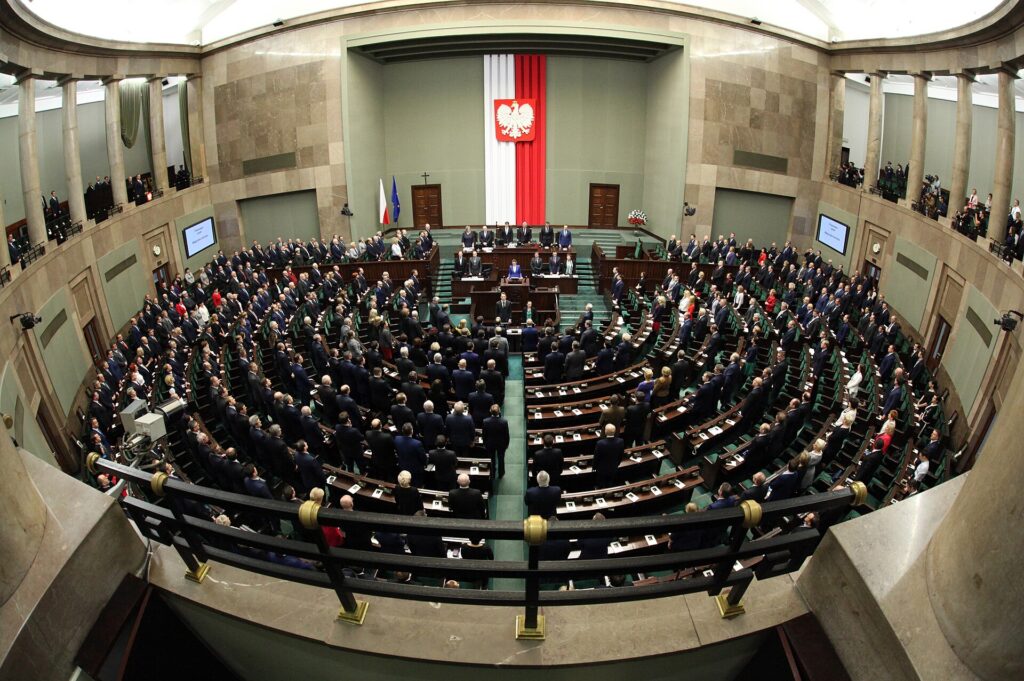
- Last month, the Polish Sejm elected 15 members of the National Council of the Judiciary (NCJ) from among judges. The National Council of the Judiciary, which counts 25 members in total, was convened for the first time with its newly elected judge members on June 11. Among those judges were candidates nominated by all parliamentary political groups.
- Meanwhile, Poland’s Constitutional Tribunal, whose rulings Donald Tusk’s government stopped publishing as early as April, 2024, had issued an interim order prohibiting the Sejm from electing members of the National Council of the Judiciary by a simple majority vote. However, since Law and Justice (PiS) MPs did not take part in the vote, the election of 15 judges to the National Council of the Judiciary was held by a three-fifths majority and therefore did not violate the Constitutional Tribunal’s order.
- Despite certain doubts, which will still be examined by the Constitutional Tribunal, it appears that the election should thus be considered valid.
- At the same time, this election by the current Sejm invalidates the entire narrative of the current ruling camp, previously supported by the European Commission, according to which the Sejm’s election of NCJ members from among judges is unconstitutional and thus impermissible.
On May 15, 2026, the Sejm, with the votes of 235 deputies of the current coalition in power, elected 15 new members of the National Council of the Judiciary (NCJ) from among judges for a four-year term. The Sejm fulfilled this obligation, which we also reminded them of, by considering the candidates proposed by all parliamentary political groups that were present at the beginning of the Sejm’s term, pursuant to Article 11d(4) of the Act on the National Council of the Judiciary.
The Sejm elected 13 judges to the National Council of the Judiciary who were proposed by the parties of the current ruling coalition, and 2 who were proposed by two opposition parties (Law and Justice and Confederation).
Despite the validity of this selection (just as the selections made in 2018 and 2022 were valid, even though the current rulers—then in opposition—claimed otherwise and enjoyed the support of the European Commission in the then-ongoing rule-of-law disputes between Brussels and Warsaw), it cannot be said that the selection took place without controversy.
Order of the Constitutional Tribunal on Interim Measures
The greatest controversy related to the election of 15 judges to the 25-member National Council of the Judiciary (NCJ) was that on May 12, 2026, acting in case K 7/26, the Constitutional Tribunal issued an order on interim relief, in which it called on the Sejm of the Republic of Poland to refrain from electing members of the National Council of the Judiciary under Article 11d(6) of the Act on the National Council of the Judiciary until the Constitutional Tribunal issues a final ruling in the case.
The order was issued in connection with a motion by a group of Members of the Sejm, who primarily sought a declaration that Article 9a(1) of the Act on the National Council of the Judiciary (providing for the election by the Sejm of the judicial component of the NCJ), understood to mean that the Sejm is bound by instructions from another state body, a non-governmental organization, in particular trade unions, socio-professional organizations, associations, civic movements, other voluntary associations, as well as foundations and professional self-government bodies, containing a list of candidates indicated by that body, is inconsistent with the Polish Constitution.
However, the issuance of the ruling did not in any way affect the Sejm’s further actions. During the meeting of the Justice and Human Rights Committee, which took place on May 12 and during which, under the NCJ Act, a list of candidates was to be determined, MP Sebastian Kaleta, presenting a candidate nominated by the Law and Justice caucus, attempted to draw the attention of the Committee Chair, MP Paweł Śliz, to the order of the Constitutional Tribunal (TK) and thus suggested postponing the selection. The chair, however, threatened to take away his right to speak, and when, just before the vote itself, Law and Justice deputies again drew attention to the ruling, the chair tried to interpret their remarks about the need to suspend the selection procedure as a withdrawal of the candidate put forward by their caucus. Ultimately, however, as indicated above, the Committee adopted a list of candidates that included the individuals nominated by all parliamentary groups.
Concerns about the legality of the Sejm’s continued consideration of the list were raised by the association Sędziowie RP (“Judges of the Republic of Poland”), which on May 14 addressed the Sejm with an appeal to suspend the procedure for electing members of the National Council of the Judiciary, stating that:
In the event that the Sejm—in violation of the order granting interim relief—were to elect members of the National Council of the Judiciary, that election would be tainted by an irremediable legal defect, and a Council so constituted would lose the capacity to adopt resolutions. Such action will only deepen the legal chaos in the justice system. Therefore—guided by responsibility and concern for the justice system—we demand immediate compliance with the Constitutional Tribunal’s ruling.
This appeal, too, was ignored—the vote in the plenary took place, as noted above, on May 15, at the end of the current sitting of the Sejm. Just before the vote, MPs Michał Wójcik of PiS and Przemysław Wipler of Confederation once again invoked the Constitutional Tribunal’s ruling, and the latter concluded his remarks with:
[…] in light of the additional interim measure granted by the Constitutional Tribunal, you are all surely aware that the people who will now be elected to the National Council of the Judiciary, will be challenged and, ultimately, will probably be removed.
Nevertheless, the vote was held, while Law and Justice lawmakers did not participate in it, presumably not wanting to legitimize it and considering it unacceptable. However, the outcome of such a decision turned out to be the opposite of what they had expected.
It should be emphasized that the Constitutional Tribunal’s order granting interim relief specifically prohibited making a selection pursuant to Article 11d(6) of the Act on the National Court Register. This provision states that:
In the event of failure to elect the members of the Council in the procedure specified in paragraph 5, the Sejm shall elect the members of the Council by an absolute majority of votes in the presence of at least half of the statutory number of Deputies, voting on the list of candidates referred to in paragraph 4.
This provision sets out a fallback procedure in the event that members of the National Council of the Judiciary (NCJ) are not elected under the ordinary procedure, provided for in paragraph 5 of this provision, by a three-fifths majority vote:
Under the ordinary procedure, i.e., in the first round of voting, the Sejm elects the members of the Council for a joint four-year term, at the next sitting of the Sejm, by a 3/5 majority of votes in the presence of at least half of the statutory number of Members of the Sejm, voting on the list of candidates referred to in paragraph 4.
Since Law and Justice MPs did not take part in the vote, the required three-fifths majority was only 155 votes, which meant the ruling coalition had no trouble securing it. Accordingly, the selection was made on the basis of Article 11d(5) of the Act on the National Council of the Judiciary, which does not fall within the scope of the Constitutional Tribunal’s order on interim relief, rather than paragraph 6. In the event that Law and Justice deputies had taken part in the vote, the required majority would have been about 270 deputies, and the ruling coalition would not have been able to obtain it. Section 6 (concerning election by an absolute majority of votes) would then likely have been applied, in violation of the Constitutional Tribunal’s ruling.
However, that did not happen, and, therefore, it must ultimately be concluded that, due to the political decision of Law and Justice lawmakers, the election did not violate the Constitutional Tribunal’s order for interim relief.
Iustitia’s Reaction
Immediately after the start of the term of office of the new members of the Council elected from among judges, the Association of Polish Judges IUSTITIA announced that:
The National Council of the Judiciary is returning to the path of constitutional and European standards.
– even though the members of the Council were elected for another term under exactly the same provisions and following the same procedure as in 2018 and 2022. This procedure, after all, was harshly criticized by the IUSTITIA Association, which up to now had persistently maintained that all judges recommended by the NCJ after 2018 and who received presidential appointments on the basis of those recommendations are “neo-judges,” meaning that they are not genuine judges (on the grounds that, in their view, as well as in the view of the current governing authorities and the European Commission, they were recommended by a NCJ dependent on the legislative branch because it is elected by the Sejm, rather than by the judicial community itself).
This fact cannot be changed by the so-called “judicial primaries” held this year to select candidates for the parties forming the ruling coalition. These primaries, lacking any legal basis, were merely informal and were not widespread (many judges, as well as entire courts—first and foremost the Supreme Court, the Supreme Administrative Court, and the voivodeship administrative courts—did not participate in them).
Particularly outrageous in this respect is the conduct of Judge Wojciech Buchajczuk, elected on May 15 to the NCJ on the basis of the same procedure, for participation in which he demanded disciplinary and criminal liability for the then members of the NCJ of the previous term.
It should be noted here that the aforementioned notification was taken very seriously by the then Minister of Justice and Prosecutor General Adam Bodnar, who, as we reported, initiated disciplinary proceedings against the then members of the NCJ for the mere fact of serving on the Council.
In light of the current situation, these proceedings should be promptly concluded, and so should the practice of undermining the status of judges and the judgments issued by them solely on the grounds that they were appointed by the President of the Republic of Poland at the request of the National Council of the Judiciary (NCJ), whose judicial component was elected pursuant to Article 9a et seq. of the Act on the National Council of the Judiciary. Of course, given the current governing majority’s attitude toward the rule of law, one should not expect it to abandon the above narrative. No action should be expected from the European Commission either, which, since the political camp it favors took power in Poland, has ceased to be interested in rule-of-law issues in Poland.
Summary
The above does not, of course, mean that the choice made on May 15 raises no doubts whatsoever. As noted above, we raised the issue of the so-called “judicial primaries,” conducted without a legal basis and, it appears, in violation of the provisions governing the processing of personal data. However, the potential liability of individuals participating in them and organizing them is a separate issue from the question of their impact on the validity of the election, on which one should await the Constitutional Tribunal’s judgment in case K 7/26.
Another issue that attracted little public attention, and which was pointed out by the Speaker of the Sejm himself, was the submission to the Speaker of the Sejm, pursuant to Article 11a(6) of the Act on the National Council of the Judiciary, of information covering the judicial record of certain candidates, including socially significant or precedent-setting decisions, and material information concerning conduct in office, primarily revealed during inspections and audits, by persons impersonating the presidents of individual courts. This issue could potentially affect the validity of the procedure; however, it would likely be difficult to demonstrate its impact on the outcome. It seems, however, that the Constitutional Tribunal should also consider it (it is not within the scope of the petition in case K 7/26).
It should, however, be emphasized that the election of NCJ members from among judges under Article 9a et seq. of the NCJ Act by the current governing majority—i.e., exactly as in 2018 and 2022—thus constitutes a complete contradiction of that very majority’s narrative about the unconstitutionality of those very provisions. In this respect, it should therefore be acknowledged that—leaving aside doubts about violations that will be examined by the Constitutional Tribunal —it was actually a good thing that the Sejm, with a different majority, also made use of that very procedure. Under normal circumstances, this should allow for solidification and consolidation and, thus, for the widespread acceptance of this institution.
The first meeting of the National Council of the Judiciary (NCJ) in its new composition is scheduled for June 11.
Image source – Wikipedia.