
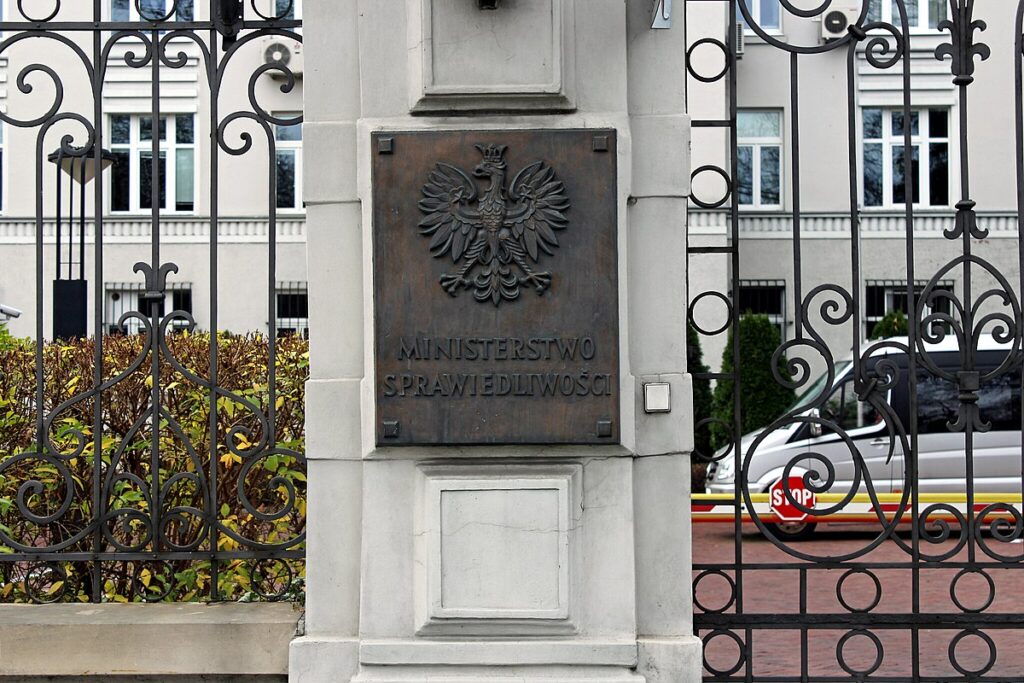
- Deputy Justice Minister Dariusz Mazur publicly assured that the judicial members of Poland’s current National Council of the Judiciary (NCJ) were chosen by judges “in universal, transparent elections,” in which a majority of common court judges were said to have taken part.
- The Nationwide Association of Judges “Aequitas” asked the Ministry of Justice, under Poland’s Act on Access to Public Information, to disclose the basis of its estimates.
- The Ministry replied that it has neither the minutes of judges’ assemblies, nor voting records, nor data on how many judges were entitled to vote or voted.
- Judge Łukasz Zawadzki has established the actual turnout at about 39% of all serving judges.
The dispute over Poland’s National Council of the Judiciary (NCJ) — the constitutional body that selects candidates for judicial office — has been raging since 2017, when the then-ruling majority transferred the election of the Council’s fifteen judicial members from the judges themselves to the Sejm, the lower house of Poland’s parliament. The European Commission intervened forcefully against that reform, as it was recounted for the European Centre for Law and Justice (ECLJ) in “The European Commission’s Attack on the Reform of the Justice System in Poland” and “The Reform of the Polish Judicial Council and the Independence of the Judiciary.” The coalition governing Poland since the end of 2023 has always maintained that the mode of electing the NCJ’s judicial members applied since 2018 is unconstitutional, even though Poland’s Constitutional Tribunal confirmed its constitutionality in 2019. Yet this year, that same coalition had new judicial members of the NCJ elected under exactly the same procedure, claiming that everything is now in order because the parliamentary vote was preceded by judicial “pre-elections.” However – far fewer judges took part in those “pre-elections” than the government has claimed — and that it was in fact the pro-government judges’ associations that picked the new NCJ members subsequently elected by the ruling coalition.
Introduction
On August 7, 2026, the Nationwide Association of Judges “Aequitas” published the outcome of almost two months of correspondence with the Ministry of Justice. Behind a seemingly minor dispute over words lay a fundamental question: were the judicial “pre-elections” held on April 20, 2026 really what they were publicly presented to be?
The Ministry asked for 41 days for “time-consuming work” — then admitted it has no documents
On June 11, 2026, Deputy Justice Minister Dariusz Mazur suggested in a post on X that the current composition of the NCJ — unlike those elected in 2018 and 2022 — is legal, allegedly because “the bulk of the judicial part of the NCJ was chosen by judges in universal, transparent elections.”
“Aequitas” immediately asked, under freedom-of-information law, for the documents behind this categorical assertion. The Ministry first gave itself until July 31, citing “time-consuming work.” When the reply came, it stated that the Ministry:
does not have (with one exception) the minutes of the general assemblies
of judges and that
it is not possible to state the number of persons who did or did not take part in the assessment of the candidates.
Yet a representative of that same Ministry had publicly asserted precise turnout figures:
nearly 60% of common court judges, a majority of military court judges.
Did any “pre-elections” take place in the Supreme Court, as the Ministry claims?
The Ministry had also assured that
the vast majority of lawful Supreme Court judges
took part. Yet, asked for the basis of that claim, the Ministry admitted that it
has no documents showing an assessment of candidates to the NCJ by Supreme Court judges
and no voting results. Its source, it conceded, was that
Supreme Court judge Włodzimierz Wróbel announced the fact of the assessment of the candidates on Facebook.
The government’s entire narrative of universal, transparent elections thus rested on a social media post.
The actual turnout: 39%
Without official documents, there can be no talk of transparency. Nor did the “pre-elections” have any legal basis: neither the Law on the System of Common Courts nor any other statute empowers judges’ assemblies to assess candidates to the NCJ — and no assemblies were held at all in the Supreme Court or the administrative courts.
Based on publicly available official data, Judge Łukasz Zawadzki calculated that Poland has 10,584 judges. Dividing the 61,603 votes cast by the 15 votes each judge could cast, about 4,107 judges took part — a turnout of roughly 39%.
The candidates backed by the judges’ associations “Iustitia” and “Themis” received 51,942 votes — 84% of the votes cast, but barely 33% of what the entire judicial community could have cast. A body that is supposed to represent the whole judiciary thus obtained the support of one third of it.
“Pre-elections” contrary to international standards
The Ministry claims that the “pre-elections” bring the NCJ back into line with
European standards.
Yet in opinion CDL-AD(2025)038 of October 2025, concerning Spain’s judicial council, the Venice Commission assessed precisely such a model — candidacies backed by judicial associations, followed by pre-elections and a final vote in parliament — and found it insufficient to meet European standards.
The Venice Commission stressed that the selection of judicial council members must be protected not only from external political influence but also from internal politicization exercised through judges’ associations, and warned in particular against systems in which a single judge may cast multiple votes, as favoring well-organized associations.
Conclusion: the current NCJ’s status must be the same as that of its two predecessors
The judicial “pre-elections” were thus neither universal nor transparent, and whether they were legal at all remains an open question. They did not even satisfy the assumptions of the Sejm’s own resolution of February 27, 2026, which declared that the Sejm would take into account
the results of elections carried out by judges in universal and transparent elections.
As we can see, however, the “pre-elections” were neither universal nor transparent. The Act on the National Council of the Judiciary is clear: the NCJ’s judicial members are elected by the Sejm from among candidates nominated either by two thousand citizens or by twenty-five judges. It provides for no “pre-elections” and no assessment of candidates by judicial self-government bodies.
On May 15, 2026, the Sejm elected the judicial part of the Council on the basis of exactly the same statutory provisions, and in exactly the same procedure, as the compositions of 2018 and 2022. Consequently — either all three compositions of the National Council of the Judiciary are legal, or none of them is. In light of the Constitutional Tribunal’s judgment of March 25, 2019 (case K 12/18), which found those provisions constitutional, the first option must be considered correct.
A factual act devoid of legal basis does not cure a procedure previously denounced as defective. Under the principle of legality enshrined in Article 7 of Poland’s Constitution, what took place outside the law is legally irrelevant — and cannot serve to differentiate the status of bodies elected in an identical procedure. This is nothing new – we have been emphasising it ever since the dispute over the shape of the National Council of the Judiciary began. In light of the information revealed by the National Association of Judges ‘Aequitas’, however, it may come as something of a surprise – or perhaps, rather, a cause for sadness – to see just how flimsy the grounds are for the categorical assertions fed to the public by representatives of the Ministry of Justice.
Such an attitude, however, is unfortunately no longer surprising on the part of a camp whose leader – Donald Tusk, just before becoming Prime Minister – declared that they would proceed:
in accordance with the law
but:
as we understand it.
Source of illustration: Wikipedia.