
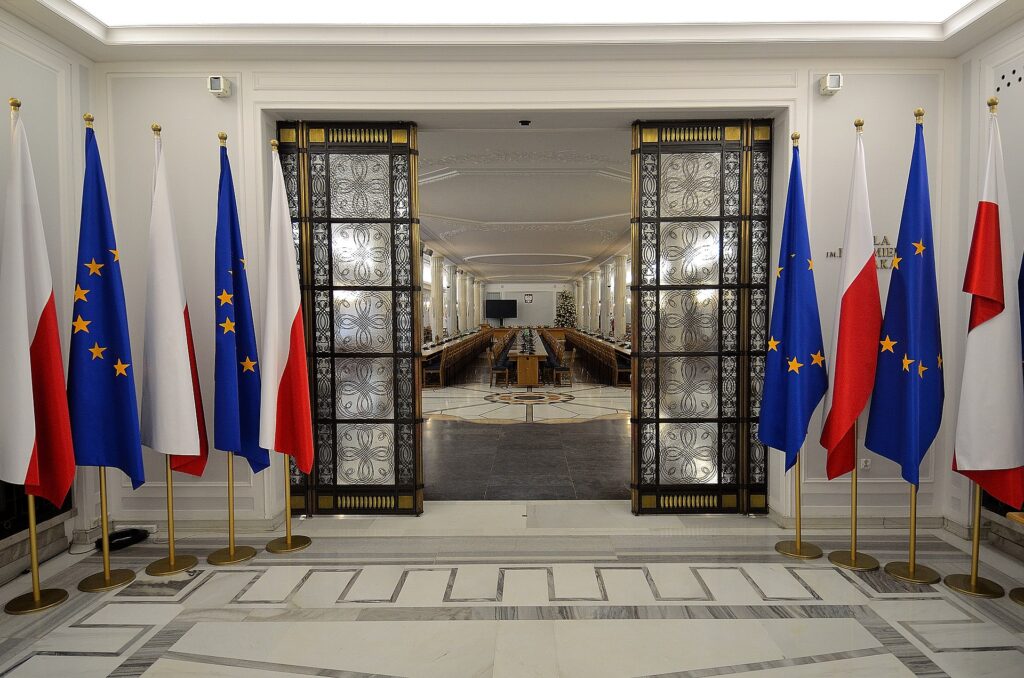
- On April 9, 2026, in the building of the Sejm of the Republic of Poland, in the presence of the Speaker of the Sejm, Włodzimierz Czarzasty, from The Left Party (which is part of Donald Tusk’s governing coalition), and in the absence of the President of the Republic of Poland, Karol Nawrocki, six persons elected as judges of the Constitutional Tribunal on March 13 of this year took the oath of office. Among them, two—Magdalena Bentkowska and Dariusz Szostek—had already taken a valid oath before the President of the Republic of Poland, Karol Nawrocki, on April 1.
- The conduct of four individuals who, after the oath had been read out in the Sejm, demanded to be allowed to adjudicate in the Constitutional Tribunal, may, in the opinion of the Chancellery of the President of the Republic of Poland, be considered a refusal to take the oath before the President of the Republic of Poland, which, under the law, is tantamount to relinquishing the office of a judge of the Tribunal. In turn, the active participation in the entire event by the two individuals who had already been validly sworn in may expose them to the risk of disciplinary liability.
- Justice Minister Waldemar Żurek issued unspecified threats should 4 people be barred from taking office as judges of the Constitutional Tribunal. However, allowing those very individuals who have not taken the oath required by law before the President of the Republic of Poland would be illegal and would expose the President of the Constitutional Tribunal to legal consequences.
As we have already written, on March 13, 2026, the Sejm of the Republic of Poland elected 6 people to positions as judges of the Constitutional Tribunal. This choice raised some concerns, which were extensively discussed in a detailed analysis by the Ordo Iuris Institute. These concerns are particularly significant given that, at the same time, before the Constitutional Tribunal, proceedings to examine whether the current procedure for appointing judges of the Constitutional Tribunal complies with the Constitution of the Republic of Poland are pending.
In light of the above circumstances, the President of the Republic of Poland twice—on March 18 and 23—raised concerns with the Speaker of the Sejm about the conduct of the entire selection procedure, requesting that they be addressed.
However, the Speaker did not respond to the President’s summons, but limited himself to a general statement in which he stated that the selection was made in accordance with the law, after which he appealed to the President to take:
immediate steps to enable the persons elected by the Sejm of the Republic of Poland on March 13, 2026, to assume office as judges of the Constitutional Tribunal in the judicial positions that had previously been vacant.
Soon, other government officials adopted an even more confrontational stance. On March 26, 2026, Prime Minister Donald Tusk explicitly announced his intention to break the law:
The judges will be sworn in. If the president doesn’t want to be present for this, well then, there’s nothing I can do about it. They’ll be judges either way.
Meanwhile, President Karol Nawrocki, without waiting for the Constitutional Tribunal to issue a ruling, on April 1 unexpectedly invited two people elected by the Sejm—Magdalena Bentkowska and Dariusz Szostek—to take the oath to assume office as judges of the Constitutional Tribunal. The main reason given for this decision was that, for the Constitutional Tribunal (CT) to adjudicate in full bench, in accordance with Article 37(2) of the Act on Proceedings before the Constitutional Tribunal, at least 11 judges are required—exactly as many as the bench will comprise after two oaths are taken.
An open declaration of lawlessness
Meanwhile, on March 8 the media received information that the persons selected by the Sejm had allegedly sent the day before (March 7) to the President of the Republic of Poland, Karol Nawrocki, an invitation to a “ceremonial swearing-in” that was to take place the following day in the Sejm building.
According to the text of one such invitation revealed by “Rzeczpospolita” (signed by Marcin Dziurda), it contained the following phrase (which gives the wrong year of publication of the Official Journal):
In the absence of any response from the Chancellery of the President, I kindly invite the President on April 9, 2026, at 12:30 p.m., to the Sejm of the Republic of Poland, where I will take the oath to assume the duties of a judge of the Constitutional Tribunal (Articles 4 and 5 of the Act of November 30, 2016, on the status of judges of the Constitutional Tribunal, Official Journal of 2028, item 1422).
The Head of the Chancellery of the President of the Republic of Poland addressed the matter, calling the initiative a sham and pointing out that no one other than the President is authorized to conduct the swearing-in, and thus the announced event will have no legal effect.
An even more unequivocal statement was issued the following morning. It emphasized, on the one hand, that the President did not refuse to accept the oath from four persons elected on March 13, but only postponed its administration for the time necessary to clarify the outstanding doubts, citing the Constitutional Tribunal judgment of December 3, 2015 in case K 34/15, which allowed such a possibility. Above all, however, the statement’s conclusion indicated that:
such ostentatious and deliberate actions contrary to the law should be treated as a refusal to take the oath under the procedure set out in Article 4(1) of the Act on the Status of Judges of the Constitutional Tribunal. […] Such refusal, in turn. has the effect expressly provided for in Article 4(2) of the said Act, under which a refusal to take the oath is tantamount to resigning from the office of a judge of the Constitutional Tribunal.
Nevertheless, an explicit announcement of the ceremony appeared on the Sejm’s website, concerning:
the presentation of resolutions of the Sejm on the election by the Sejm of judges of the Constitutional Tribunal and the oath before the President of the Republic of Poland.
Lawlessness in the Sejm
The announcement, unfortunately, has been carried out. On March 9, at 12:30 p.m., in the Column Hall of the Sejm of the Republic of Poland, all six individuals elected on March 13 appeared: Maciej Taborowski, Dariusz Szostek, Krystian Markiewicz, Anna Korwin-Piotrowska, Marcin Dziurda, and Magdalena Bentkowska. Also present were the Speaker of the Sejm, Włodzimierz Czarzasty, and the Speaker of the Senate, Małgorzata Kidawa-Błońska, as well as—as was explicitly emphasized by the master of ceremonies, who was not introduced by name—a notary public (whose name is, as follows from later media findings, Dariusz Kramarz). However, as was to be expected, neither the President of Poland himself nor any of his representatives were present.
Nevertheless, after the Speaker of the Sejm had presented the resolutions on the election, the chair asked them to:
take the oath before the President of the Republic of Poland.
To which a voice from the audience aptly replied:
But the President isn’t here!
Despite this valid objection, after some hesitation, Magdalena Bentkowska was the first to step to the center of the hall and, despite having already taken the oath before the President of the Republic of Poland a week earlier, she read the text of the oath aloud again, after which she was asked to sign it. Before the next invited speaker took the floor, the voice from the audience once again pointed out:
I remind you that the President of the Republic of Poland is not here.
Perhaps in response to this, subsequent oath-takers began their statements with the phrase:
I am addressing the President of the Republic of Poland.
Apart from Magdalena Bentkowska, only Dariusz Szostek, who, just as her, had already duly taken the oath before the President on March 1, omitted this introduction, reciting only the text of the oath.
It didn’t take long for the Chancellery of the President to respond. Indeed, it soon indicated that, in light of the event that took place in the Sejm, the remaining four individuals are not only still not judges of the Constitutional Tribunal, but in fact, by acting as they did, made it impossible for the President of the Republic of Poland to accept their oath of office in the future.
Meanwhile, in the afternoon, all six individuals selected on March 13 went to the seat of the Constitutional Tribunal. There, the President of the Constitutional Tribunal, Bogdan Święczkowski, announced that rooms and cases to handle had been assigned to both judges who took the oath on April 1. Until then, , notwithstanding their obligation arising from Article 5 of the Act on the Status of Judges of the Constitutional Tribunal, they had not yet appeared at the Tribunal to take up their duties. However, judge Święczkowski indicated to the remaining four persons that they had not entered into a service relationship with the Constitutional Tribunal, as they had not received from the President a confirmation that the oath had been taken before him.
Shortly after, Justice Minister Waldemar Żurek called for allowing all six persons elected on March 13, 2026, to adjudicate in the Constitutional Tribunal (TK). At the same time, he proposed rather peculiar ways of resolving doubts about their status: he advised those challenging it to turn in this matter to… “independent European courts”! Such courts are of course in no way authorized to adjudicate both specifically on the personnel matters of the Polish judiciary and more generally in disputes concerning Polish constitutional law.
It appears that even the persons chosen for the Constitutional Tribunal are aware of the defective nature of their “oath”, as both Krystian Markiewicz and Anna Korwin Piotrowska have not yet resigned their positions as judges of the ordinary courts, even though pursuant to Art. 98 § 2. of the Law on the System of Common Courts:
A judge who has been appointed, nominated, or elected to serve in state authorities […] is required to immediately resign from office, unless they retire.
Consequences of the illegal “ceremony”
The consequences of what happened on Thursday in the Sejm building primarily threaten the participants themselves. As indicated above, the Chancellery of the President of the Republic of Poland has openly expressed the position that taking the oath in the absence of the President and treating it as sufficient for assuming the duties of a judge of the Constitutional Tribunal, may be deemed equivalent to a refusal to take a proper oath, and that, in light of Article 4(2) of the Act on the Status of Judges of the Constitutional Tribunal:
it is equivalent to resignation from the office of judge of the Tribunal.
A similar opinion was also expressed by Professor of Constitutional Law Ryszard Piotrowski, who stated that:
If, therefore, in the view of the persons taking the oath, this constituted taking the oath, that means they refused to take the oath before the President.
Attorney Bartosz Lewandowski, well known in Poland for representing two former ministers who have obtained asylum in Hungary in connection with the gross rule of law violations by the Tusk government, also warned of such a consequence of the announced act, even before the Chancellery of the President issued a statement.
In turn, the two Constitutional Tribunal judges who, despite having already taken valid oaths of office, decided to take part in the “ceremony” in the Sejm building and reenact the taking of the oath, thereby exposed themselves to the risk of disciplinary liability under Article 24 et seq. of the Act on the Status of Constitutional Tribunal Judges:
for violation of the law, conduct unbecoming the dignity of the office of a judge of the Tribunal, violation of the Code of Ethics for Judges of the Constitutional Tribunal, or other unethical behavior that may undermine confidence in the judge’s impartiality or independence.
– which may even carry the penalty of removal from office.
Likewise, Sejm Speaker Włodzimierz Czarzasty, who should be considered the actual organizer of the “ceremony”—for which, moreover, he announced that he assumes joint responsibility—must be prepared for the possibility of incurring criminal liability for exceeding his powers under Article 231 of the Criminal Code.
The broader context of the case needs to be reminded here. Indeed, there may be doubts as to whether the President of the Republic of Poland acted properly by accepting the oath from two people on April 1, both with regard to limiting himself at all to only some of the six who had been elected and with regard to the choice of those particular individuals.
It should, however, undoubtedly be emphasized once again that in the event of well-founded doubts, the President may withhold the decision to administer the oath. This issue has been extensively discussed in an analysis of the Ordo Iuris Institute. This is confirmed especially by the case of Lidia Bagińska, who was elected a judge of the Constitutional Tribunal by the Sejm on December 8, 2006, but for more than three months was not invited by the President of the Republic of Poland, Lech Kaczyński, to take the oath of office due to doubts about her candidacy. At that time, however, it did not occur to anyone that a person elected by the Sejm could, of their own accord, take the oath without the President’s active approval.
In connection with Ms. Bagińska’s case, another important ruling was also handed down. Ms. Bagińska was ultimately sworn into office in March 2007; however, a few days later, she announced her resignation from the office of judge of the Constitutional Tribunal, only to change her mind yet again and file a lawsuit seeking a declaratory judgment that she continued to serve on the Tribunal. The case was ultimately resolved by Poland’s Supreme Court in the order of November 5, 2009, I CSK 16/09, which held that:
the determination of the existence of the right to exercise the mandate of a judge of the Constitutional Tribunal
does not fall within the jurisdiction of the common courts. In light of the foregoing, any attempt by the 4 individuals selected on March 13, who did not take a valid oath, to pursue recognition of their status before the civil courts (including labor courts) is doomed to fail from the outset.
Of course, one should not expect the government to easily give up its efforts in this matter. Minister Żurek has already announced in his usual style that:
Any attempts to prevent legally elected judges of the Constitutional Tribunal from performing their duties will be met with a decisive response from the state.
In this context, it should be noted that on the same day that six persons were elected to the Constitutional Tribunal, the Sejm also adopted a resolution “on the measures necessary to ensure that the Constitutional Tribunal meets the requirements of a court established by law, independent and impartial”, in which it above all unjustifiably challenged the status of Bogdan Święczkowski as President of the Constitutional Tribunal.
Such a resolution obviously cannot produce any legal effects. However, the government has repeatedly undertaken various unlawful actions (against the Constitutional Tribunal, the National Council of the Judiciary, and the public media) precisely on the basis of such resolutions. There is therefore reason to fear that the government may be planning a forcible entry into the Constitutional Tribunal’s headquarters, similar to what happened this January at the National Council of the Judiciary. It should be noted that such a solution would, of course, be unlawful, and if it were undertaken, it would have to be added to the already long list of violations of the rule of law, for which the current government—led by its Prime Minister and Minister of Justice—should be held accountable.
Summary
In connection with the de facto usurpation by the Speaker of the Sejm (and the notary accompanying him) of the President of the Republic of Poland’s exclusive authority to administer the oath to persons elected as judges of the Constitutional Tribunal, the President of the Republic of Poland—acting in line with the recommendation of the Ordo Iuris Institute—announced the filing with the Constitutional Tribunal of a motion to resolve a constitutional dispute.
It therefore seems that all the parties to the dispute should refrain from taking any further action until this dispute is resolved, as well as until the Constitutional Tribunal issues a ruling in case K 3/26. For now, such a declaration has come from the Chancellery of the President.
Of course, we can hardly expect similar statements from this government. However, one thing should be kept in mind: Regardless of whether what took place on April 9 in the Sejm building is deemed to have resulted in resignations from the offices of judges of the Tribunal or not, it is beyond doubt that the persons who have not taken a valid oath before the President of the Republic of Poland cannot be permitted to perform the duties of judges of the Constitutional Tribunal, and any attempts to force this through will be manifestly unlawful.
Illustration source: Wikipedia.

