
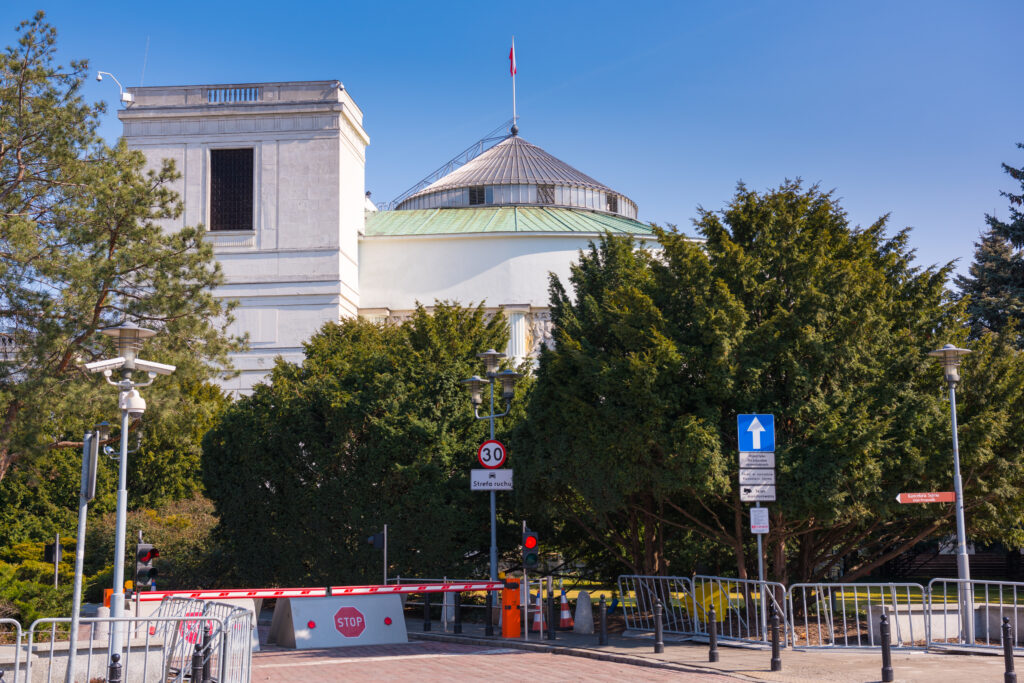
- After the current EU-backed left-liberal governing majority in Poland refused four times to nominate its candidates to the Constitutional Tribunal (TK), whose verdicts it stopped publishing and executing two years ago, the Speaker of the Sejm, Włodzimierz Czarzasty, unexpectedly announced on March 9, 2026, another deadline for submitting nominations.
- However, the deadline for this and the subsequent deadline for their election by the Sejm were extremely short—two days—and contrary to the general rules contained in the Rules of Procedure of the Sejm and to good parliamentary practices.
- The Chair of the Sejm Committee on Justice and Human Rights, Paweł Śliz of Poland 2050, a party that is part of the governing coalition, initially refused to allow civil society representatives to participate in the Committee meeting at which candidacies for judges of the Constitutional Tribunal were to be considered. Then, 40 minutes before the Committee meeting, he unexpectedly changed his mind. Ultimately, however, during the meeting, the civil society representatives were not allowed to speak.
- Ultimately, on March 13, the ruling majority selected 6 candidates it recommended. However, the vote was held in violation of the Sejm’s Rules of Procedure.
Currently, as many as 6 of the 15 seats in the Constitutional Tribunal remain vacant because of the governing coalition’s refusal to appoint new judges up to now. The Rules of Procedure of the Sejm define the procedure for electing judges to the Constitutional Tribunal (TK), and they are elected by the Sejm by a simple majority for a nonrenewable 9-year term. Pursuant to Article 30(3)(1) of the Rules of Procedure of the Sejm, motions nominating a specific candidate must be submitted no later than 30 days before the expiration of the term of office of the judge vacating a seat on the Tribunal. Meanwhile, the current ruling majority decided four times not to put forward its candidates within the above-mentioned deadline, and subsequently rejected in votes (February 21, 2025, May 9, 2025, September 12, 2025, and January 23, 2026) the candidates nominated by the opposition.
Procedural concerns regarding the actions of the ruling majority
Unexpectedly, at the beginning of this week—on Monday, March 9—the Speaker of the Sejm from the “Left” party, also part of Donald Tusk’s coalition, Włodzimierz Czarzasty, set the deadline for further nominations for judges of the Constitutional Tribunal to March 11. This meant that the entities authorized to submit nominations (that is, the Presidium of the Sejm—the Speaker and Deputy Speakers making decisions by majority vote, or at least 50 members of the Sejm) had just two days to nominate candidates.
While the above decision raises serious doubts from the standpoint of political culture, it appears that Article 30(3)(5) of the Rules of Procedure of the Sejm, which allows the Speaker to set a new date where it is impossible to make the selection while observing the aforementioned 30-day deadline before the end of the term of office, in fact provides no guidelines for setting such a date. However, it is different with regard to another decision by the Speaker, who, in announcing the list of nominated candidates, stated that:
The chamber will elect judges to the Constitutional Tribunal during Friday’s block of votes.
Meanwhile, pursuant to Article 30(4) of the Rules of Procedure of the Sejm, such a vote:
shall not take place earlier than the seventh day following delivery to the Deputies of the document containing the nominations, unless the Sejm decides otherwise.
However, the Sejm did not at that time adopt any resolution that would have allowed such an early start to voting. It was only on the day of the vote that the Speaker presented a motion to shorten the time limit, which, amid general uproar and chants of “Donald Tusk, Donald Tusk,” he deemed adopted by tacit consent.
Both the manner in which the time limit was shortened and the shortening itself, without any justification being provided, should be assessed in a decidedly negative light from the standpoint of political culture and good parliamentary practice. The rulemaker’s intent was clear: the time limits for submitting nominations and for thoroughly considering them should not be arbitrary, but sufficiently long to enable a genuine parliamentary debate.
Meanwhile, the current ruling majority is acting on this issue in a way that is clearly at odds with the above intentions.
Restriction on civil society participation
Moreover, on March 12, the EU-backed ruling majority, which so often boasts about “restoring the rule of law”, committed yet another violation of good practices in this regard. For, pursuant to Article 30(5)–(8), motions concerning the election or appointment by the Sejm of individual persons to state offices should be referred by the Speaker of the Sejm to the competent Sejm committee for an opinion, whereas consideration by the Sejm of such a motion may not take place earlier than the day following the day on which deputies are served with the printed document containing the committee’s opinion. In this respect—despite the possibility provided for in paragraph 8 of this Article of the Rules of Procedure of the Sejm—no decision was made to shorten the time limit or to dispense altogether with referring the motion to the committee, whose meeting was in fact scheduled for March 12 at 5:00 p.m.
Requests to be allowed to participate in the committee’s work were submitted by a number of civil society organizations, including representatives of the Ordo Iuris Institute, who wanted the opportunity to ask questions of the judicial candidates. Pursuant to Article 154(3) of the Rules of Procedure of the Sejm:
By invitation of the committee presidium or its chair, representatives of professional and social organizations, committee experts, and other individuals may participate in committee meetings.
The practice to date in applying this provision has been that, in the vast majority of cases, representatives of organizations who contact the Committee Secretariat are invited to attend a meeting of the Committee, during which they are given the floor. Meanwhile, as for today’s Committee, the representatives of the social partners were informed at 11:30 that:
Chairman Paweł Śliz did not consent to the participation of representatives of civil society organizations in today’s Committee meeting. The session will be streamed online on the Sejm’s website.
No reason for this decision was given. Such a decision should undoubtedly be assessed negatively, both in terms of parliamentary customs and good practices and in terms of the principles of civil society and participatory democracy. This decision is all the more surprising given that Chairman Śliz is a member of the Poland 2050 parliamentary group, one of whose pledges was “An open Sejm for the citizens.”
It should therefore come as no surprise that this decision elicited decidedly negative reactions on social media. Perhaps for this reason, at 4:19 p.m., only a little over half an hour before the start of the Committee meeting, the chair changed his mind again, as a result of which the Committee Secretariat reported that:
Chairman Paweł Śliz changed his decision on the matter and agreed to allow representatives of organizations to attend today’s Committee meeting. The registered individuals have been added to the guest list.
While the decision itself should be assessed positively, the circumstances under which it was issued—at a time when so little time remained before the Committee session was to begin, when the ability of representatives of the social partners to arrive on time was very much in doubt—should also be assessed negatively.
Ultimately, civil society representatives were not allowed to speak; in particular, they were not given the opportunity to ask the candidates questions.
Proceedings of the committee meeting
However, lawmakers from both the ruling camp and the opposition made extensive use of the opportunity to ask questions. It is worth quoting a few of the most interesting statements that were made in the responses.
In one of the first rounds of questions, opposition MP Marcin Warchoł asked Judge Anna Korwin-Piotrowska (nominated by the Presidium of the Sejm, i.e., by the ruling majority), President of the Main Board of the Themis Judges’ Association (an association that makes no secret of its support for the current government), the following question:
What is Your Honor’s opinion on the non-publication of the Constitutional Tribunal’s judgments in the official Journal, and when, in your view, should these rulings begin to be published?
The response was short and to the point:
There is no doubt that the judgments of the Constitutional Tribunal must be published
Such an answer is consistent with the position of the current composition of the Constitutional Tribunal and entirely at odds with the practice of the current ruling majority.
Another question asked by the same MP was addressed to Professor Marcin Dziurda (also nominated by the ruling majority) and read as follows:
Is it permissible to withhold salaries from the Constitutional Tribunal’s judges?
The response was also unequivocal:
Of course, both under statutory provisions and under general principles of law, salaries to persons who serve in the relevant roles should be paid.
This was also a position consistent with the recent ruling of the Constitutional Tribunal, but at odds with the practice of the current ruling majority.
Another position worth citing was that expressed by Attorney Michał Skwarzyński, Ph.D. (nominated by a group of Law and Justice MPs), who, in response to a question about the so-called “duplicate judges,” argued that using this term is unjustified, since there were grounds to consider all elections of judges carried out by the Seventh-term Sejm (by the votes of the ruling majority led by Civic Platform) unconstitutional. The candidate pointed out (which we, too, have raised on this page) that at the time the selection was made, it was not yet known when the then Sejm’s term would end. In Poland, the term “duplicate judges” refers to three judges who were elected at the end of 2015 by the newly elected Sejm to seats that had been filled in advance by the previous Sejm.
However, very important declarations were made in response to a question about the “status” of the Constitutional Tribunal’s ruling of October 22, 2020 (case no. K 1/20), which held the permissibility of abortion on the grounds of a diagnosis of an incurable disease or defect of the unborn child unconstitutional under the Constitution of the Republic of Poland and whose validity the current governing majority disputes. The responses were provided by Judge Anna Korwin-Piotrowska, Attorney Magdalena Bentkowska, and Attorney Michał Skwarzyński.
The first response (by the Judge) was exceptionally evasive—on the one hand, she stated that:
The decision was issued, and it was published.
On the other hand, she suggested that every criminal court ruling on the offense of “termination of pregnancy” will have to:
determine whether this judgment of the Constitutional Tribunal exists in law and whether it can produce legal effects with respect to the decision that was issued.
The judge indicated that perhaps—if an appropriate motion is filed with the Tribunal—the Constitutional Tribunal (TK) should reconsider the decision set out in that judgment, but she cautioned that she cannot at this time state what decision it should make.
On this occasion, the judge also resorted to a certain degree of manipulation, suggesting that the issue above is in fact about balancing between the good of a child’s life and the need to:
to save the mother’s life.
Meanwhile the Constitutional Tribunal’s ruling in case K 1/20 did not concern the issue of a threat to the life or health of a pregnant woman at all—in this respect, nothing has changed in the Polish legal system!
A decidedly clearer answer was given by Attorney Magdalena Bentkowska, who stated that, in light of CJEU case law:
The proceedings must be deemed defective, and the ruling must be deemed null and void.
Only Attorney Skwarzyński emphasized that, first, the judgment is final and cannot be overturned in any way—including by invoking EU law, which, in the hierarchy of Polish sources of law, ranks below the Constitution and moreover provides a lower standard of protection of life than that derived from the Polish Constitution. Secondly, he emphasized that even if one were to completely disregard the participation of the so-called “duplicate judges” in rendering the judgment, the remaining judges would still have constituted both the required majority to issue the judgment and the required composition of the bench—especially since one of the so-called “duplicate judges” voted against the operative part of the judgment.
Ultimately, the meeting lasted four and a half hours, despite the fact that, as noted above, the social partners were not allowed to speak. Its effect may be something of a (positive) surprise: The committee issued a favorable opinion on all seven candidates present at the session, including the opposition’s candidate, Attorney Skwarzyński. Ultimately, however, it didn’t matter.
Sejm vote
On March 13, 2025, the Sejm put to a vote the nominations for judges of the Constitutional Tribunal. Only the candidates nominated by the ruling majority received an absolute majority of votes; that is, in addition to the previously mentioned Judge Anna Korwin-Piotrowska, Professor Marcin Dziurda, and Attorney Magdalena Bentkowska, Judge Professor Krystian Markiewicz (former president of the Iustitia judges’ association), Professor Maciej Taborowski, and Professor Dariusz Szostek.
However, right before the vote itself, there was another violation of the Sejm’s Rules of Procedure. The rapporteur appointed by the Committee—MP Patryk Jaskulski—did not mention at all what the Committee’s opinion was regarding the candidacy of Attorney Michał Skwarzyński—he only listed, one by one, the six candidates put forward by the Presidium of the Sejm, stating for each that the Committee’s opinion was positive, and for the last one—Maciej Taborowski—he added that:
This candidate received significantly fewer votes than the other candidates.
In fact, however, this remark aptly describes Michał Skwarzyński, not Maciej Taborowski. The rapporteur’s conduct was undoubtedly contrary to Article 43(7) of the Rules of Procedure of the Sejm, according to which:
The rapporteur may not present, in their report, any proposals other than those included in the committee report.
Summary
All of the above calls into question the effectiveness of the choice of new constitutional judges by Poland’s lower house of Parliament. It seems that the only reason for this haste, the bending of procedure, and the violation of parliamentary customs and best practices is the desire to elect candidates before the Constitutional Tribunal rules on the constitutionality of the current procedure for selecting its members. The hearing on this matter was to be held on Tuesday, March 17, 2026 (the Constitutional Tribunal, however, postponed the issuance of its ruling on that date without setting a new date).
In the application initiating the proceedings in this case, one significant point was undoubtedly made: the conduct of the current ruling majority leads to the circumvention of Article 194(1) of the Polish Constitution, under which the Sejm elects judges to the Constitutional Tribunal individually for 9-year terms. Just as the then Sejm majority (drawn, after all, from the same political camps as the one being currently in power) violated in 2015 the principle of fixed terms for Constitutional Tribunal judges by electing them in advance, even though it knew that at least some of the positions would only become vacant during the next term of the Sejm, so now the Sejm is trying to manipulate the terms from the other end—by delaying the election of Constitutional Tribunal judges, so that subsequent parliaments (in which, by all indications, the current ruling camp will not have a majority) have to contend for longer with a majority of its members who will likely be unfavorable to the new ruling majority. As this action comes in addition to the government’s practice to date, which has been, for the last two years, to ignore the Constitutional Tribunal’s rulings, including unlawfully refusing to publish them, it is all too clear that the aim of the Tusk government is to completely neutralize the Constitutional Tribunal—so as to eliminate one of the last bodies empowered to point out violations of the rule of law committed by the current government under the auspices of the European Union.
Looking at the problem from the other side, one should ask what the President, who, pursuant to Article 4 of the Act on the Status of Judges of the Constitutional Tribunal, receives the oath from those judges, will do. Only as of that moment, pursuant to Article 5 of the Act, is the service relationship of a judge of the Tribunal established. Most certainly, particularly in light of the Constitutional Tribunal’s judgment of December 3 (in case K 34/15), the President should refrain from accepting the oath until the Constitutional Tribunal issues a judgment in the case currently pending before it. President Karol Nawrocki will likely also take into account, when making his decision, the procedural concerns about the selection process followed by the current Sejm.
Image source: iStock.
