
- On January 21, 2026, a forcible entry was carried out at the offices of the National Council of the Judiciary in Warsaw. Approximately 100 police officers, accompanied by two military prosecutors acting pursuant to orders issued by Prime Minister Tusk, entered the premises and removed all relevant judicial files, including documentation concerning disciplinary proceedings involving judges politically associated with the Prime Minister, as well as files relating to the alleged coup d’état attributed to him.
- During the course of this operation, physical force was reportedly used against judges and administrative staff present on the premises, and their personal liberty was unlawfully restricted. These actions, in the author’s assessment, constitute an unlawful intervention by the executive branch in the functioning of the judiciary and an infringement on the remaining institutional guarantees of judicial independence in Poland.
- Legal counsel from Ordo Iuris were present during the operation, acting in their capacity as representatives of members of the Council, and observed the actions undertaken by the police and prosecutors.
- It is further anticipated that the Supreme Court may be subjected to a similar intervention in order to obstruct the scheduled election of a new Chief Justice (President of the Supreme Court), which is expected to take place in late February or early March.
- The timing of the operation is alleged to have been deliberate, having been conducted on a date when President Nawrocki was outside the country, attending the World Economic Forum in Davos.
The Disciplinary Prosecutor for Judges of the Common Courts is an important position in the Polish judiciary and an important element of the system of “checks and balances” within the separation of powers. Pursuant to the provisions of the Law on the System of Common Courts, the Disciplinary Prosecutor initiates disciplinary proceedings against judges who violate the duties incumbent upon them and acts as the prosecutor before the disciplinary court in such proceedings. Pursuant to Article 112 § 3 of the Act—Law on the System of Common Courts, the Minister of Justice appoints the Disciplinary Prosecutor for Judges of the Common Courts and two deputies for a four-year term; however, no provision authorizes the Minister to remove the Prosecutor before the end of the term.
Meanwhile, as early as the spring of last year, Adam Bodnar, the former Minister of Justice in Donald Tusk’s government, announced the dismissal of the Disciplinary Prosecutor for Judges of the Ordinary Courts—Judge Piotr Schab—after which, acting in an obviously unlawful manner, he announced the appointment of Judge Mariusz Ulman to that position. In August of last year, after Adam Bodnar had already been replaced by Waldemar Żurek as Minister of Justice, representatives of the Ministry of Justice attempted to enter the Disciplinary Prosecutor’s offices, located in the headquarters of the National Council of the Judiciary (KRS—a body which, pursuant to Article 186 of the Constitution of the Republic of Poland, safeguards the independence of courts and the independence of judges), demanding the handover of disciplinary case files. However, they were not admitted at the time, and Judge Dominik Czeszkiewicz, the director of the Ministry’s Department of Administrative Supervision who took part in the attempt, insisted in a press interview that:
I definitely won’t be going in with the police or a moving company. Let’s be serious. We will take legal action.
Shortly after that raid, Judge Mariusz Ulman, ceased posing as the Disciplinary Prosecutor, after which he gave a press interview, in which he said the following:
It is not possible to circumvent or change a statute, let alone the constitution, by regulations or by de facto action. Just as some in the judicial community wanted – by throwing the National Council of the Judiciary out onto the street, since such ideas also surfaced. The main allegation against me was that I didn’t remove the previous spokespeople from the KRS office. I have a somewhat different approach to the law, to the application of the law, and to the exercise of my office. That doesn’t mean, of course, that it can’t be done. You can go and throw it away, but that means that then we’re breaking the law.
Apparently, however, the leadership of the Ministry of Justice had a different view on the matter and decided not only to break the law but also to renege on its own commitments.
Intrusion by the Prosecutor’s Office into the National Court Register (KRS)
On January 21, 2025, at around noon, two prosecutors — Tomasz Narłowski and Zbigniew Rzepa arrived at the headquarters of the National Council of the Judiciary, escorted by the police. Prosecutors demanded the handover of the files of disciplinary cases conducted by the Disciplinary Prosecutor for Judges of the Ordinary Courts and his deputies.
W biurze @KRS_RP jest dwóch prokuratorów, policja czeka. Żądają od kierownika sekretariatu akt postępowań dyscyplinarnych. Panowie prokuratorzy nie wyrażają zgody na udostępnienie wizerunu. Autorem postanowienia jest Prok. TOMASZ Narłowski. pic.twitter.com/jH89ajds6A
— Dagmara Pawełczyk-Woicka (@DPawelczykW) January 21, 2026
The subsequent course of action should be described as rather turbulent. The police took control of all the entrances to the building, initially prohibiting anyone from entering or leaving it. As a result, the media were prevented from entering the premises, and the chair of the KRS, Judge Dagmara Pawełczyk-Woicka, was also denied the opportunity to hold a press conference at the headquarters of the body she heads. The police told also, that: “the Prosecutor’s Office is taking over the building“.
Sceny w budynku KRS. Nie pozwalają na wejście. Policja przejęła siedzibę. pic.twitter.com/jdBgRVTkpg
— Dagmara Pawełczyk-Woicka (@DPawelczykW) January 21, 2026
Prosecutors initially also stated that they did not consent to the recording of their image, although under Article 81(2) of the Copyright Act such consent is not required in the case of:
a public figure, if the likeness was created in connection with the performance of their public functions, in particular political, social, or professional.
In connection with the above actions by the Prosecutor’s Office, the Chairwoman of the KRS has already submitted to the prosecutors a notice of a suspected criminal offense due to the restriction of her liberty and the obstruction of her ability to perform her professional duties.
Szanowni Państwo,
— Kamila Borszowska-Moszowska (@Kamilabormosz) January 21, 2026
nagranie zarejestrowane przez sędziego @AdamJaw78742019 w siedzibie @KRS_RP w sposób jednoznaczny obrazuje zarówno sposób zachowania prokuratora, jak i przebieg czynności podejmowanych w siedzibie @KRS_RP.
Zgodnie z art. 81 ust. 2 pkt 1 ustawy o prawie… pic.twitter.com/SrL2xy33Zz
Members of Parliament also arrived at the scene to conduct parliamentary interventions. However, the police also tried to prevent them from entering the building, even though under Article 19(1) of the Act on the Exercise of the Mandate of a Deputy and a Senator:
In performing their mandate, a deputy or senator has the right, provided they do not infringe the personal rights of others, to obtain information and materials, to enter premises where such information and materials are located, and to inspect the activities of government administration bodies and local self-government, as well as companies with State Treasury shareholding and state and local government establishments and enterprises, subject to the provisions on legally protected secrecy.
Po wielu przepychankach w drzwiach, interwencji Przewodniczącej @KRS_RP do siedziby biura Rady udało się wejść dwóm posłom: @DariuszMatecki i @MWosPL Oblężenie budynku trwa. Mediów nie wpuszczono mimo mrozu. Być może dojdzie do kolejnego "prucia szaf" z aktami. pic.twitter.com/Cb2nGMlfXU
— Krajowa Rada Sądownictwa (@KRS_RP) January 21, 2026
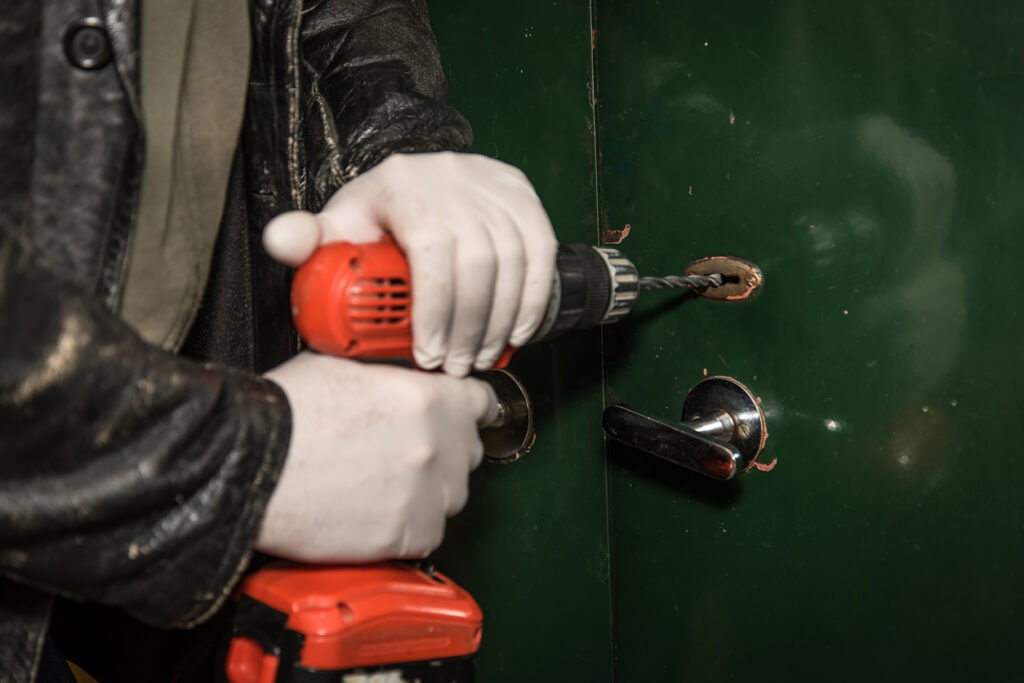
Because, on the one hand, due to the absence of the Disciplinary Prosecutor for Judges of the Ordinary Courts, but above all due to the lack of any substantive grounds for doing so, the prosecutors were not given the disciplinary files; they ordered the drilling of the locks—first, of the doors to the offices of the Disciplinary Prosecutor, his deputies, and secretariat staff, and then the drilling of the locks of the safes in which the files were kept.
Czynności prokuratury i policji w @KRS_RP trwają. Ale na razie "poległy" zamki do pokoi. Szafy jeszcze nie. pic.twitter.com/3iXqqTvgJQ
— Krajowa Rada Sądownictwa (@KRS_RP) January 21, 2026
‼️ Policja sforsowała drzwi do biur Sędziów KRS w poszukiwaniu materiałów dowodowych rzecznika dyscyplinarnego Schaba.
— Jan Molski 🇵🇱 (@JanMolskiIII) January 21, 2026
Obrzydliwe. Akurat jak sejm ma posiedzenie, a Karol Nawrocki jest w Davos. pic.twitter.com/7gqjW4spau
Pierwsza szafa w @KRS_RP stawia opór. Na razie otwierana jest delikatnie. Jest 15.39 i nadal w siedzibie Rady pełno policji, prokuratorzy, pełnomocnicy prawni wezwani przez Radę, zastępca Rzecznika Dyscyplinarnego Sędziów Sądów Powszechnych Michał Lasota i sędzia Zbigniew Łupina pic.twitter.com/cW0CdPzuBt
— Rzecznik Prasowy Krajowej Rady Sądownictwa (@RzecznikKRS) January 21, 2026
Ultimately the files were taken out, making it impossible to document exactly what was taken.
Z KRS zabierają wszystko. Jeden z sędziów poprosił żeby chociaż zdjęcia dzieci ze ścian zostawili. Bandyckie metody zostaną rozliczone. Zabierają każdy dokument, każdy segregator, bez spisywania dokładnie co w nich jest. Celowo. Kto im udowodni jeśli coś zniknie albo coś dorzucą? pic.twitter.com/ee8TSscpQG
— Dariusz Matecki (@DariuszMatecki) January 21, 2026
The activities did not end until after midnight. Attorneys from the Ordo Iuris Institute, who were present on site at all times, filed nearly 40 objections to the prosecution’s decision and the actions it carried out.
Po północy kolejnego dnia, po 12 godzinach opuszczamy wraz z mec. @MagdaMajkowska siedzibę @KRS_RP. W naszych zastrzeżeniach do samego postanowienia prokuratury, jak i do przeprowadzonych czynności znalazło się blisko 40 punktów. Postanowienie zostało wydane 14 stycznia.… pic.twitter.com/R8Zg2Bd0Mz
— Bartosz Malewski (@BartoszMalewski) January 21, 2026
The government accuses the Disciplinary Prosecutor of a crime that the government itself is committing.
Initially, shortly after the first media reports of the intrusion into the KRS headquarters, the motives for the intrusion were unknown to the public. It is therefore understandable that concerns arose as to whether the Prosecutor’s Office, following earlier declarations by Minister Żurek, was planning to forcibly remove the current membership of the KRS, just as earlier the legitimate National Prosecutor was removed.
Not until about 2 p.m., nearly two hours after the operation began, did an official statement appear on the National Prosecutor’s Office website, explaining the reasons for the operation:
Order [regarding a demand for the surrender of items and a search] was issued in an investigation conducted by the Internal Affairs Department of the National Public Prosecutor’s Office under case file no. 1001-14.Ds.21.2025, concerning the usurpation of the office of the Disciplinary Prosecutor of the Judges of the Common Courts and his deputies by persons who had been stripped of those offices, as well as the concealment of documentation concerning disciplinary proceedings of judges and court assessors by refusing to produce it, i.e., offenses under Article 276 of the Penal Code and Article 227 of the Penal Code.
The collected evidence indicates that despite being dismissed by decisions of the Minister of Justice from serving as Disciplinary Prosecutors, the identified judges continued – as unauthorized persons – to undertake actions falling within the exclusive competence of the Disciplinary Prosecutors for common court judges. At the same time, despite repeated requests issued by the newly appointed disciplinary prosecutors and the so-called ad hoc disciplinary prosecutors, the case files of the disciplinary proceedings were not released to authorized persons.
The above position can hardly be described as anything other than a veritable pinnacle of duplicity on the part of the Prosecutor’s Office. As we have repeatedly pointed out – the Minister of Justice could not remove Judge Piotr Schab from the post of the Disciplinary Prosecutor for Judges of the Courts (nor his deputies), because no provision of law authorizes him to do so!
As noted at the outset, Article 112 § 3 of the Law on the System of Common Courts authorizes the Minister only to appoint the Disciplinary Prosecutor for Judges of the Common Courts and two of his deputies for a four-year term, but is silent on removal from office. This fact was acknowledged by the Ministry of Justice itself in its official statements. From the principle of legality (Article 7 of the Constitution – Public authorities act on the basis of and within the limits of the law), it follows unequivocally that if no provision grants a given public authority the competence to act in a specified manner, then it simply cannot act in that manner.
Moreover — the Supreme Court has addressed the above issue at least several times, allowing the lawful Disciplinary Officer and his deputies to participate in proceedings before the Chamber of Professional Responsibility, while not allowing ministerial nominees.
So it is not Piotr Schab, nor his duputies – Przemysław Radzik and Michał Lasota – who should be suspected of committing the offenses referred to in Article 276 of the Penal Code (destroying or concealing documents) and Article 227 of the Penal Code (impersonating a public official), but rather precisely Joanna Raczkowska – allegedly nominated by Minister Żurek to the position of the first of them. All the more so since she in fact granted herself the right to perform activities related to the function of the Disciplinary Prosecutor, including in particular announcing the removal of the Disciplinary Prosecutor’s regional deputies. In fact, a disciplinary proceeding has already been initiated on that basis against her by the lawful regional deputy of the Disciplinary Prosecutor.
Also, the prosecution’s raising of the fact of the appointment, in certain proceedings, of Disciplinary Prosecutors of the Minister of Justice, i.e., the so-called ad hoc Disciplinary Prosecutors, is irrelevant to the case. Admittedly, pursuant to Article 112b(1), second sentence, of the Law on the System of Common Courts:
The appointment of the Minister of Justice’s Disciplinary Prosecutor precludes any other disciplinary officer from undertaking procedural steps in the case.
– it should nevertheless be emphasized that, in connection with the application filed by the KRS seeking a finding of the unconstitutionality of the institution of ad hoc ombudspersons, the Constitutional Tribunal issued on January 8, 2025 an order for interim relief, in which it ordered the suspension of any actions by ad hoc prosecutors. In light of the above, the Disciplinary Prosecutor for Judges of the Common Courts should not only not hand any files, but indeed it is the Minister’s Disciplinary Prosecutors who should return to him the files that were seized during the first forcible entry by the Prosecutor’s Office into the KRS headquarters, which took place in July 2024.
Returning to the Ministry’s statement, it was also specified therein that:
Procedural actions are conducted exclusively on the premises occupied by the Office of the Disciplinary Prosecutor. They do not extend to premises related to the activities of the National Council of the Judiciary and in no way infringe the autonomy of that body.
Meanwhile, however, pursuant to Article 112 § 4 of the Act on the System of Common Courts:
The National Council of the Judiciary provides administrative support to the Disciplinary Prosecutor for Judges of the Common Courts and to the Deputy Disciplinary Prosecutors for Judges of the Common Courts by creating a separate organizational unit within the Office of the National Council of the Judiciary.
Providing support for the Disciplinary Prosecutor for Judges of the Common Courts is therefore very much a task of the KRS and interference in this matter indeed constitutes a violation of the autonomy of this body. All the more so given that the Presidium of the National Council of the Judiciary, back in July 2025, issued a statement in which it unequivocally declared that, in carrying out the above statutory duty, it would provide administrative support to Piotr Schab, Przemysław Radzik, and Michał Lasota as the legitimate Disciplinary Prosecutor and his deputies.
However, in their statements, representatives of the Ministry tried to argue that the actions concerned allegedly dismissed Disciplinary Prosecutors rather than the KRS, using this as an argument for their legality. However, readers rightly pushed back, pointing out—as, for example, Attorney Bartosz Lewandowski did—that the Minister simply could not remove the Disciplinary Officer and his deputies, because the authority to appoint them does not, by itself, confer the authority to remove them.
Proszę nie mydlić nikomu oczu.
— Bartosz Lewandowski (@BartoszLewand20) January 21, 2026
Gdyby wczoraj dostał Pan pismo bezpośrednio od @prezydentpl, że jest Pan odwołany i nie jest Pan już wiceministrem, chociaż nikt nie składał wniosku o odwołanie, to spakowałby się Pan dzisiaj i wyszedł z budynku MS?
Podobnie jest z rzecznikami.…
It is worth recalling at this point the protest action described on our pages by the ‘Sędziowie RP’ association, which called on the President of the Republic of Poland, Andrzej Duda, to dismiss the Minister of Justice-Prosecutor General, Adam Bodnar, pointing out that according to the Minister’s logic, since the Polish President can appoint ministers (in accordance with Articles 154 and 161 of the Constitution of the Republic of Poland), he can also dismiss them.
This distinction—that the actions were directed at the Disciplinary Prosecutor rather than the National Council of the Judiciary—was, however, considerably weakened by Minister Żurek himself, who at the very outset referred to the National Council of the Judiciary as:
neoKRS, i.e., an improperly constituted body […].
Gdy instytucje państwowe blokują dostęp do akt i łamią prawo – wkracza prokuratura. Tak to wygląda w państwie prawa.
— Waldemar Żurek (@w_zurek) January 21, 2026
A gdy mówimy o neoKRS, czyli organie ukształtowanym w sposób wadliwy, dopowiem – nikt nie może zasłaniać się budynkiem ani uzurpowanym stanowiskiem, by stać… pic.twitter.com/kSjtxpMgN7
This is, of course, a position contrary to what the Constitutional Tribunal ultimately confirmed in the judgment of March 25, 2019 (K 12/18), in which it expressly held that the currently applicable provisions of the Act on the National Council of the Judiciary (KRS), regulating the manner of electing the judge-members of the KRS, are consistent with the Constitution.
Nevertheless, in light of the above statements by the Minister, especially when made in such a context, one can, and even should, be concerned that the Ministry may attempt to act in a similar way also against the judge-members of the National Council of the Judiciary (KRS) themselves, leading to their forcible removal from the building. Perhaps the government intends to implement the above scenario with respect to the Supreme Court as well, where an election for a new President is to be held in late February or early March.
Context of the Prosecutor’s Office Actions – An Organized Operation?
There is no doubt that the timing at which the Prosecutor’s Office decided to carry out the above actions was no accident. Although the order was issued as early as January 14, the Prosecutor’s Office waited exactly one week to execute it. What could have been the reason for this?
On January 21, the Sejm considered two draft bills prepared by Minister Żurek that contained manifestly unconstitutional provisions. The first of these provided for the removal from office of judges appointed since 2018, contrary to the guarantees of Article 180 of the Constitution. The other, however, provided for the restoration of the corporatist model for electing judges to the National Council of the Judiciary, thereby depriving a significant portion of judges appointed since 2018 of the right to stand for election.
With regard to the first bill, the Chairwoman of the KRS, about an hour before the proceedings began, took the floor at the Sejm podium, sparing no criticism of its unconstitutional provisions.
Dotkliwa krytyka tzw. ustawy praworządnościowej przedstawionej w #Sejm przez szefa @MS_GOV_PL @w_zurek. Przewodnicząca @KRS_RP @DPawelczykW: Projekt to zemsta! Jest to niekonstytucyjne szaleństwo! Degradacja i segregacja sędziów, a dodatkowo – chaos w sądownictwie. pic.twitter.com/0CFeA23xRh
— Krajowa Rada Sądownictwa (@KRS_RP) January 21, 2026
With regard to the second – it was no longer possible, because it was precisely during its review that the most dramatic moments of the Prosecutor’s Office raid took place.
An important factor in the choice of that day may also have been the fact that, as mentioned above, the Disciplinary Prosecutor for Judges of the Common Courts himself was on leave outside Warsaw, as was one of his Deputies. The other one, however, had a court hearing scheduled for that day. The President of the Republic of Poland, Karol Nawrocki, who did not spare harsh criticism of Minister Żurek’s actions, which were destabilizing the Polish justice system, was also outside the country, at the summit in Davos.
The meticulous planning of the operation may also be evidenced by the fact that shortly after the activities began, even before the National Prosecutor’s Office issued the aforementioned official statement, a detailed article appeared on the oko.press website, whose authors do not hide its sympathies for the government, explaining the aims and context of the activities.
It may also be worth mentioning that just two days before the operation, Minister Żurek’s nominee—Judge Raczkowska—announced (as indicated above—of course, unlawfully) the dismissal of additional regional Deputy Disciplinary Prosecutors, which can be regarded post factum as a kind of harbinger of the Ministry’s return to a hardline confrontation with the lawful Disciplinary Prosecutor.
Summary
After the Prosecutor’s actions were completed, the National Prosecutor’s Office issued a statement, in which it was stated that:
The secured documents were transported to the National Prosecutor’s Office, where they will be examined in the presence of the Disciplinary Prosecutor for Judges of the Ordinary Courts and the ad hoc Disciplinary Prosecutor of the Minister of Justice, because they contain information protected by law. Subsequently, these documents will be forwarded to the disciplinary prosecutors as the entities solely authorized to handle them.
As indicated above, neither the Minister’s nominee, posing as the Disciplinary Prosecutor for Judges of the Ordinary Courts—Joanna Raczkowska—nor the Disciplinary Prosecutors ad hoc are authorized to hold these case files or to conduct disciplinary proceedings. Accordingly, the actions of the Prosecutor’s Office, being manifestly unfounded, constitute a flagrant example of abuse of authority, i.e., the offense referred to in Article 231 of the Criminal Code. Present on site during the activities of the Prosecutor’s Office, Ordo Iuris lawyers will make every effort to ensure that any abuses committed on this occasion are properly addressed.
Source of illustration: iStock.